
Bill Nordhaus, winner of the 2018 Nobel Prize in Economics, has died. Long a professor at Yale, he was 85.
I choose to begin with a rather acidic review he wrote in 1973 of the book “World Dynamics” by Jay Forrester. A book review is a slight contribution, but it shows clearly the two themes the rest of his career would expand upon: Theory needs Good Data, and Data needs Good Theory.
In the 1960s and 70s, people were extremely concerned that we were going to run out of resources. “The Limits to Growth” sold something like 30 million copies (or so Wikipedia alleges), “The Population Bomb” sold millions more, India sterilized millions of people, and China restricted fertility in the leadup to the one-child policy. It was the time of oil crises and pollution. In popular culture, we predicted that New York City would have a population of 40 million people and we would be eating people for food. It was a rather pessimistic time.
Nordhaus might have agreed if it were based on anything solid, but it was not. His review takes apart Jay Forrester’s book as (bluntly) claptrap. It has a large model with many variables, related to each other in complicated ways, but nowhere does it try to take anything to the data. The claims adduced as facts are complete conjecture, at odds with what other reasonable people might think are accurate parameter values.
The theory is also unsatisfactory. When one is sloppy in how they treat different variables, you get obvious absurdities. For instance, Forrester’s model implies that if you were to double the number of mines and the number of forges, iron output would quadruple (with the converse implication that small decreases in resource availability would cause very large decreases in output). Forrester’s model mixes up stocks and flows, such that output depends not on the amount of resources we are consuming, but on how much there remains to be extracted.
The deeper problem with the theory is that it is not built upon individual maximization. Individuals do things which result in bad outcomes because they take actions which do not make any sense. They have no capacity whatsoever to substitute away from resources as they become more expensive, or to innovate. They simply do the same thing until the system breaks entirely.
He rejected this, and he was right. Humanity today is more prosperous than it has ever been, because humans are capable of reacting to different circumstances, adapting, learning, and improving. The environmental pessimists, not having a model with sound foundations or decent empirical data, came to bad conclusions.
Nordhaus’ career would largely consist of fixing this. He, and his successors, have succeeded in many ways, although they have not been fully successful. His framework for studying climate change has become the default because, frankly, it is the only sensible option.
Let’s start by moving away from trying to describe the effect of climate change on everything, and attack just one part about which we can say something definite – agriculture, for instance. Agriculture is particularly well-suited for studying the effects of climate change, because we possess data on the performance of crops in different climate conditions. If we have a production function for crops, of which climate is an input, we can calculate what output would fall to.
However, prior work was unsatisfactory because it did not account for people to change their behavior. Farmers, expecting changes in climate, will not be stuck myopically with the same crops forever. Mendelsohn, Nordhaus, and Shaw (1994) illustrate this with the figure below. Assuming that someone would stick with wheat forever as the climate changes misses that they would simply switch to corn after a while.
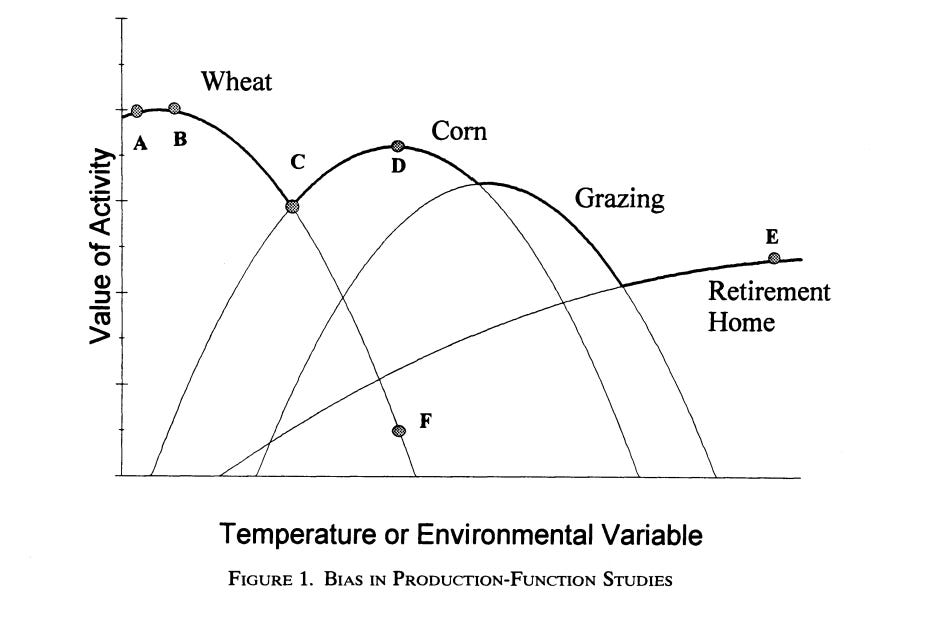
Their fix is to implicitly include the ability to adopt. If the land is used optimally, then, holding other characteristics fixed, changes in heat show up in the valuation of the land.
Later literature is a bit more explicit about the ability to switch between crops. Costinot, Donaldson, and Smith (2016) is the definitive statement, I think, in this line of literature. The UN has a dataset (the GAEZ) on the potential productivity of every crop under different climate and soil conditions. As climate change goes along, we can predict that people will change their crops, and further predict how people will trade in order to further mitigate damages.
That’s agriculture. We’ll come back to parameterizing damages for the rest of the economy, which have not been as satisfactorily answered, in a moment. Before we say anything about the effect on the whole economy, we need a sensible way to relate things together. That’s the dynamic integrated climate-economy model, or DICE.
Because it is macro, the model is rather long, but it is actually quite structurally simple. You tie together multiple modules, each of which takes in facts about the world, and gives us a number which you can take to the next module. Start with a Ramsey-Cass-Koopmans optimal growth model, where capital is combined with labor (multiplied by technology) to produce output. This leads to emissions, which enter the atmosphere and raise the temperature. This causes damages that reduce economic output. You then ask, given this function, what should the benevolent social planner choose in order to maximize utility over time?
The beauty of this is that it is extremely clear about what causes what. Every module (economy, emissions, carbon cycle, forcing, temperature) produces one number and only one number. A complicated model in which everything interacts with everything makes it impossible to see what assumption or parameter is driving the results.
This also makes modifications easier. Suppose that you are curious about what the effect of sea level rising is in a DICE model. This will probably not show up in the function mapping temperature to damages, because we will probably estimate the local effect of temperature on the economy (but the sea level depends on the temperature everywhere). It can be added simply by tacking on another module. You can then show what damages would be with and without the module, and you can clearly state how everything ties together.
Golosov, Hassler, Krusell, and Tsyvinski (2014) is the refined version of this. Given the following:
Log utility, so that richer future generations can suffer bigger absolute losses but value each dollar less, exactly cancelling;
Cobb-Douglas production, so that the optimal fraction of capital to labor is constant and we don’t need to worry about the savings rate changing over time, and;
Both climate damages are log linear in the amount of carbon and the amount of carbon is linear in emissions;
The optimal tax of carbon is the discounted expected sum of changes in output due to carbon emissions. We do not need a forecast of future technology. The optimal tax is a fixed percentage of GDP. We need only to know precisely how long carbon will stick around in the atmosphere, how much of a loss that carbon causes, and how much we discount the future. The Nordhaus agenda gave us a target to shoot at.
The weakness of the models has always been that the numbers are shakily identified. All too often, estimates of the damages of climate change rely on the simple empirical correlation that warm countries are poorer than cold countries. I have difficulty believing that the only difference between Norway and Nigeria is the temperature, and yet, this really is used. For instance, Hassler, Krusell, and Olovsson (2026), in what can be taken as a statement of what is standard and uncontroversial, presents the following function for damages and temperature.
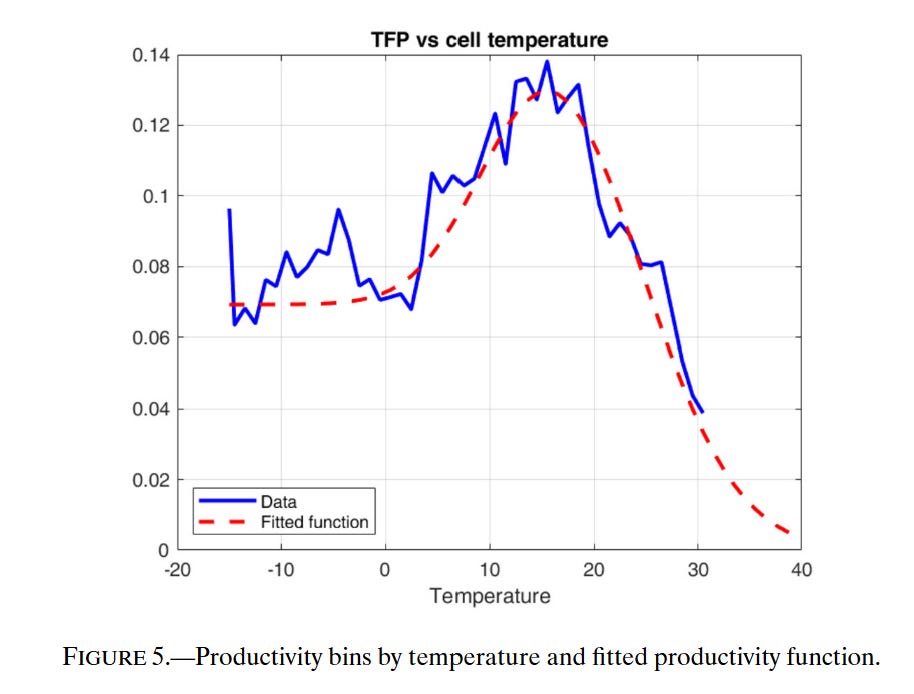
Agriculture is the ideal case because we can actually observe differences in productivity while holding everything else constant, and plausibly attribute that to climate. For everything else, we cannot.
We can also try and use microevidence. For instance, it is an uncontested fact that test scores fall on particular hot days. Conceivably, we could estimate the effect of climate change by taking every possible channel by which heat might affect the inputs into the economy, measuring each of them, and then adding
Unfortunately, things don’t quite work that easily. Take test scores. For starters, we are not sure that the test score is actually reducing the thing we are worried about. It could be that the poor performance on the day of the test is simply idiosyncratic noise, and corresponds to no change in the actual underlying skills. Goodman, Hurwitz, Park, and Smith (2019) argue that it’s actually heat over the course of the school year that matters, and heat on test day is at best a proxy for heat elsewhere in the year. Once we measure the actual amount of human capital students possess, we then need to correctly model how human capital corresponds to output, something which economists have struggled with for decades and still do not have definite answers. And once you have resolved long-standing economic issues in the effect of education on productivity, you then need to do this for every single thing that the climate might affect, missing none, and correctly modeling how they all go together, while bearing in mind that the literature for things other than test scores is much less certain.
Alternatively, you can use shocks. Dell, Jones, and Olken (2012) is the classic citation for within country shocks. They use variation in temperature from year to year, and chart the correlation with economic growth in that year. They show a large decrease in poor countries, with a 1 degree Celsius increase reducing economic growth in that year by 1.3 percentage points.
However, what we need to map the one year losses to macro models are whether those changes are persistent. We would expect shocks to be mitigated by adaptation. A snowy day when I have packed for the beaches of Cancun is a catastrophe, but an ordinary day when I am in Boston. What matters is the climate relative to what I have prepared for, and a one-off shock need not persist. If the costs come from the shock without adjustment, then it will be less in the future. On the other hand, if the damages are being mitigated by things like drawing down groundwater, then the damages will actually be greater in the future.
Relatedly, one can use global temperature shocks, as Bilal and Kanzig (2026) do. They point out that the temperature in any given country is often not what we care about for the effects of climate. If the main way that Florida gets affected by climate change are hurricanes, then we don’t care about the temperature in Florida so much as we do about the temperature off the coast of West Africa. This is completely correct, I think. However, caring about the global temperature means that we have about 60 years of time series to work with, greatly cutting statistical power. Further, the global temperature is not volatile enough to support our conjectures about the effect of climate change. We are left having to presume that if an increase in global temperature by 0.2 C causes X damage, then a rise of 1 C must cause 5X in damages – which goes some way in explaining how their finding of a rise of 1 C reduces GDP by 12%, many times greater than other estimates.
Parameterizing the model can also be a matter of ethics, not merely scientific endeavor. The clearest example is in the choice of discount rates. How much we should pay now to prevent damages later depends, naturally enough, on how much you care about the present as opposed to the future. Nordhaus characteristically used market returns to pin down this parameter, giving us a discount rate of around 1.5% per year. Other researchers, most famously the Stern Report, used 0.1%, and got numbers that were nowhere near Nordhaus – Nordhaus’s price of carbon was $30 a ton, while Stern’s was $250.
Nordhaus was very critical of the Stern Report. It is clear that, on ethical grounds, Stern favored a discount rate of zero, where future generations are equally as important as current generations. This has the unfortunate property, though, that every consumption path has infinite consumption, and it is thus not possible to rank them. The choice of 0.1% is an arbitrary one, justified by the possibility of human extinction, in order to make the math well-behaved. And yet, this is what drives all of the results. Setting the discount rate that low means that, in order to prevent damages equal to 0.01% of output starting in 2200 and continuing forever, we would be willing to pay $7 trillion now. (Partha Dasgupta (2007) pointed out that it implies an optimal savings rate of 97.5% of output too). Unfortunately, there’s just no way around the fact that the choice of discount rate will have an enormous impact on your estimate of the effects of climate change.
But enough about climate change. Nordhaus worked first in the study of innovations, and his work shows an appreciation for what humans are capable of. He is, as far as I can tell, the first person to clearly state what the optimal patent length should be. (When the benefits of creating more information equal the deadweight loss from the patent’s monopoly). He rejected the notion that we were close to running out of resources in 1974.
Special notice must be taken of his paper on the development of light, long a favorite of undergraduate syllabi. In the beginning, there was wood, a substance which when burned gives a dim light and much heat. Since then humanity has looked to produce more light with less heat and greater convenience. He finds that the cost of producing light has fallen something like a factor of 200, with this gain scarcely accounted for in the productivity statistics, and that for this reason, conventional economic analysis understates the degree of improvement in the world. I also note his 1975 paper outlining the incentives for an elected government to spend too much before an election.
Prof. Nordhaus was, without fail, forward looking. He took climate change seriously before just about anyone else, even while he rejected the most pessimistic scenarios. So it should be perhaps little surprise that one of his last essays was taking the possibility of an AI takeoff seriously. “Are We Near the Singularity?” answers that question in the negative; of the seven tests he proposes, none indicate that a singularity was happening any time soon. But, he wrote in 2015. How could you hope to forecast the future when it hasn’t happened yet? That was the war he fought. He did not win it, but neither did he lose. It is unfortunate that he will not live to see the greatest thing that humanity will do.
Rest in peace, William Dawbney Nordhaus.
This post is brought to you by Mechanize, Inc. They are hiring for a variety of positions, including software engineers. I encourage you to apply here.
Thank you for this fine tribute. I loved how clearly you laid out his big idea that good theory needs good data. It made his whole life's work easy to follow and hard to forget.
William...