
Fertility is rapidly falling in much of the world. Current projections are that population growth will halt, and total population will fall. However, if there are fewer people around we might expect the price of housing to fall as well. Since higher housing prices discourage people from having kids, the fall in price will work to increase fertility. These might balance each other out, and should certainly influence our projections.
However, the effect of housing on fertility is not something which is incorporated at all into current projections of population change. The UN World Population Prospects projection is essentially taking each cohort, imputing a belief over the path over future fertility, and eventually just having it converge to some predetermined path. The Census Bureau also projects future population for the United States. It takes the total fertility rate of 1.52 exhibited by whites in 2020, and assumes that all the other groups will linearly converge to that target. They are not trying to model the determinants of population growth. That’s what I hope to improve upon.
From a high-level point of view, here’s what the model will do. We’re building off of the Blanchard (1985) model, aka “perpetual youth”. It’s in continuous time, and people face a constant death rate. This implies that each person faces the same life expectancy, regardless of how long they’ve been in the world, which is of course unrealistic but makes things extremely clean and tractable. This death rate, mu, is set to 0.0128, which gives each person at birth a life expectancy of 78.
People are choosing how many kids to have as if they are buying a product. The cost of housing is a component of having a kid, so when it falls, people choose to have more children. The birth rate in the absence of a housing channel is calibrated to match whatever the model you are comparing to is, and it is then multiplied by the elasticity of fertility with respect to housing prices.
We could complicate the model by adding in a supply side for housing, but we will skip that. Instead, we will take the supply of housing to be fixed downward. This is not an unreasonable assumption. Housing is a durable good, and houses do not become unbuilt when population declines.
The theoretical effects of housing prices on fertility are ambiguous. On the one hand, since people need more space when they have kids, a rise in price will increase the cost of having kids. On the other hand, if one owns property, an unexpected appreciation in price makes having a kid more affordable. Thus, studies such as Aksoy (2016) or Dettling and Kearney (2016) find that increases in housing prices raise the fertility of home owners, and reduce that of renters. They find that the latter predominates, whether through being larger (as in Aksoy) or holding a disproportionate portion of the people of childbearing age.
What I will argue, though, is that we should take the effect on renters as being the “true” effect of housing on fertility in the model. If everyone has to buy in, then there should be no wealth effect, and only the costs matter. In the empirical specifications to follow, I will try a range of possible parameter values.
Identifying the effect of population on housing price is difficult, because any shock which causes people to move would also likely be correlated with a shock to the desirability. For example, we could not use the effect of Hurricane Katrina, because we are not sure if it’s impacting the price of housing by reducing the population, or through actively destroying the businesses and homes which would make someone want to live there.
There are two estimates we’re going to be using, Saiz (2007) and Glaeser and Gyourko (2005). Saiz is estimating the upward effect on prices of dumping more people in a given area, using a shift-share IV. Practically speaking, it’s taking advantage of the tendency for people to gravitate to where similar people are. When lots of people emigrate from a country, they tend to move to the places where a lot of their compatriots went before. The argument is that this is exogenous to the current conditions has been subject to criticism (read Jaeger, Ruist, and Stuhler, 2024), but ultimately I am not defending any given estimate, just wanting reasonable parameter estimates.
This is especially the case since we know pretty darn well that the response of housing price to population decline should not just be the inverse of the elasticity upward. Housing is a durable good, and the price should decline a lot when demand declines, even a little. That’s what Glaeser and Gyourko find. Of course, their approach is problematic, because it’s going to lump in shocks which make the place undesirable with changes in the population alone, holding the desirability fixed. So, what we’ll do is treat Glaeser and Gyourko as the upper end, and Saiz as the lower end, and get a range of estimates.
Anyway, here are the results. We calibrate the model such that, without including the housing channel, it will exactly match what the Census Bureau projects for the U.S. population – which, in the absence of immigration, is a decline from 335 million now to 226 million in the year 2100 – and then have a range of possible parameters.
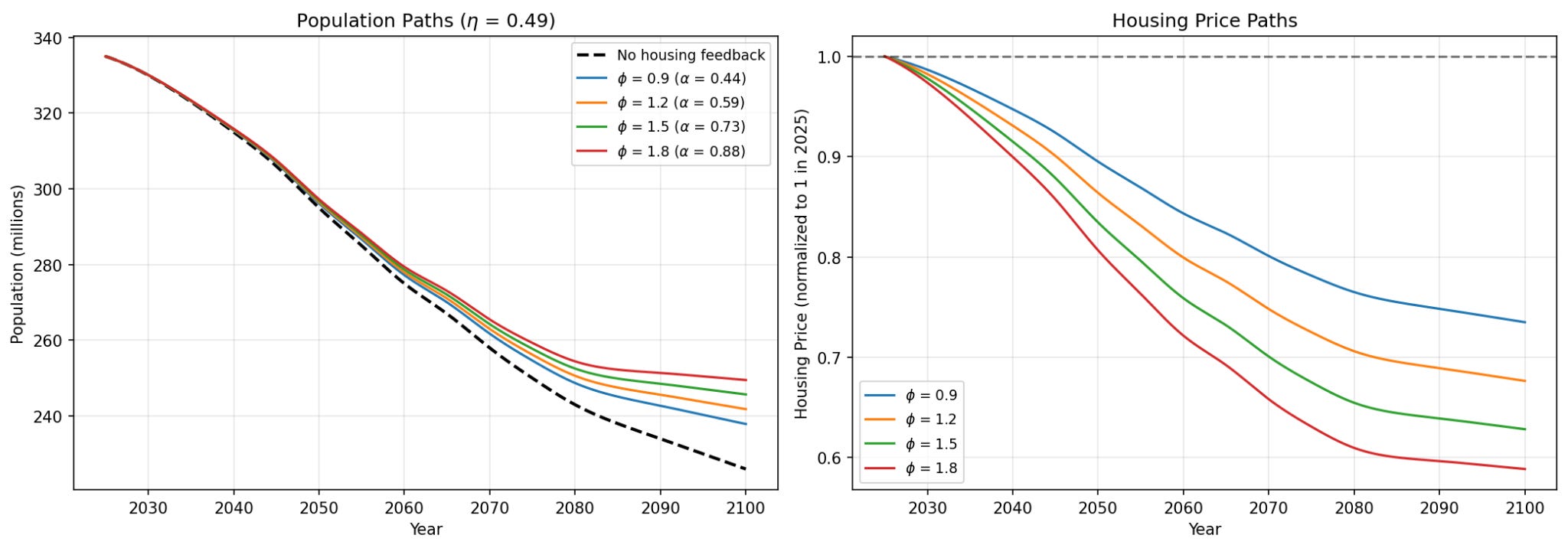
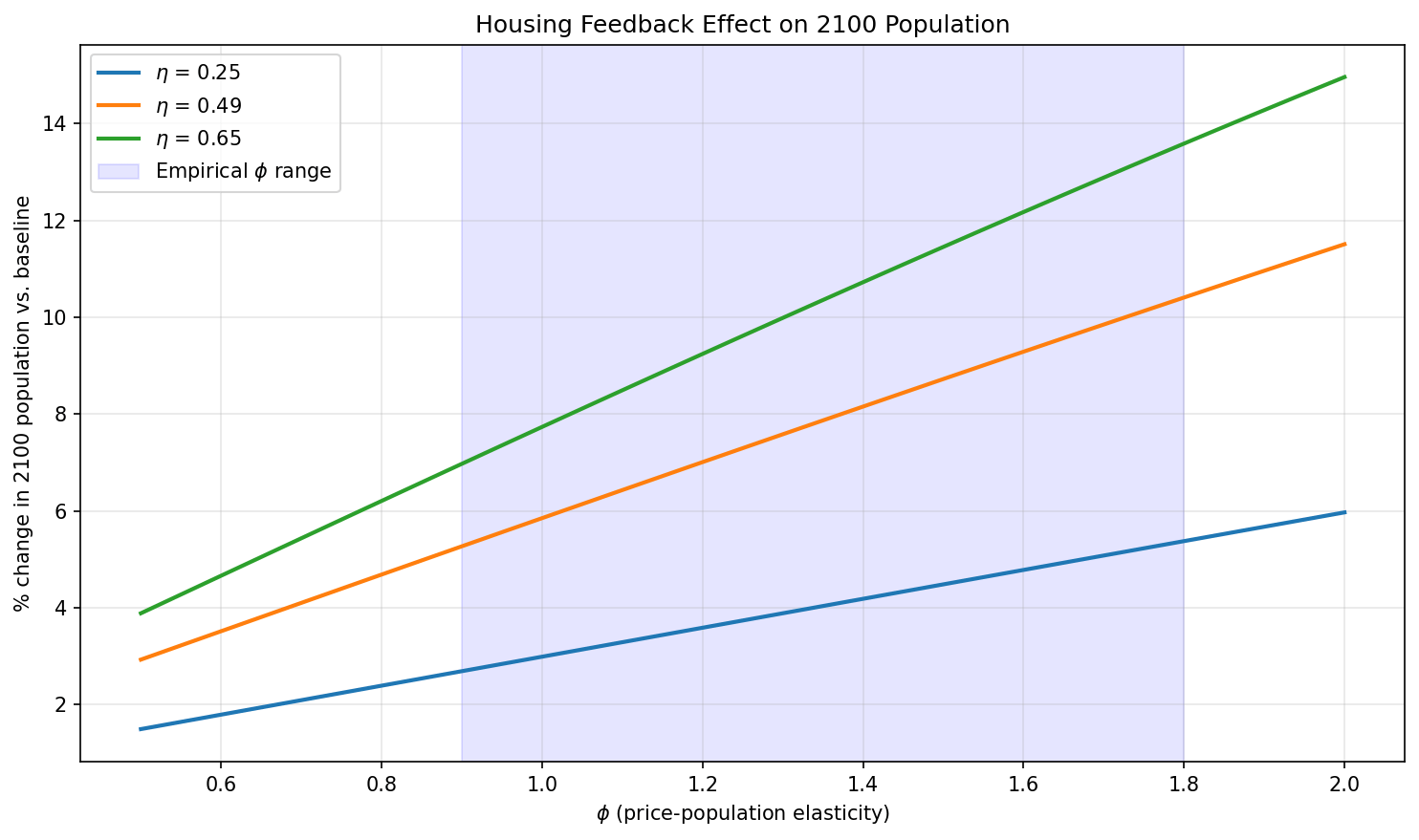
Adding in feedback from housing prices to increases the population of the United States in 2100 by 12 to 24 million people, an increase of 5.3% to 10.4%. We do not enter a steady state, nor will we ever, but the decline in population is attenuated.
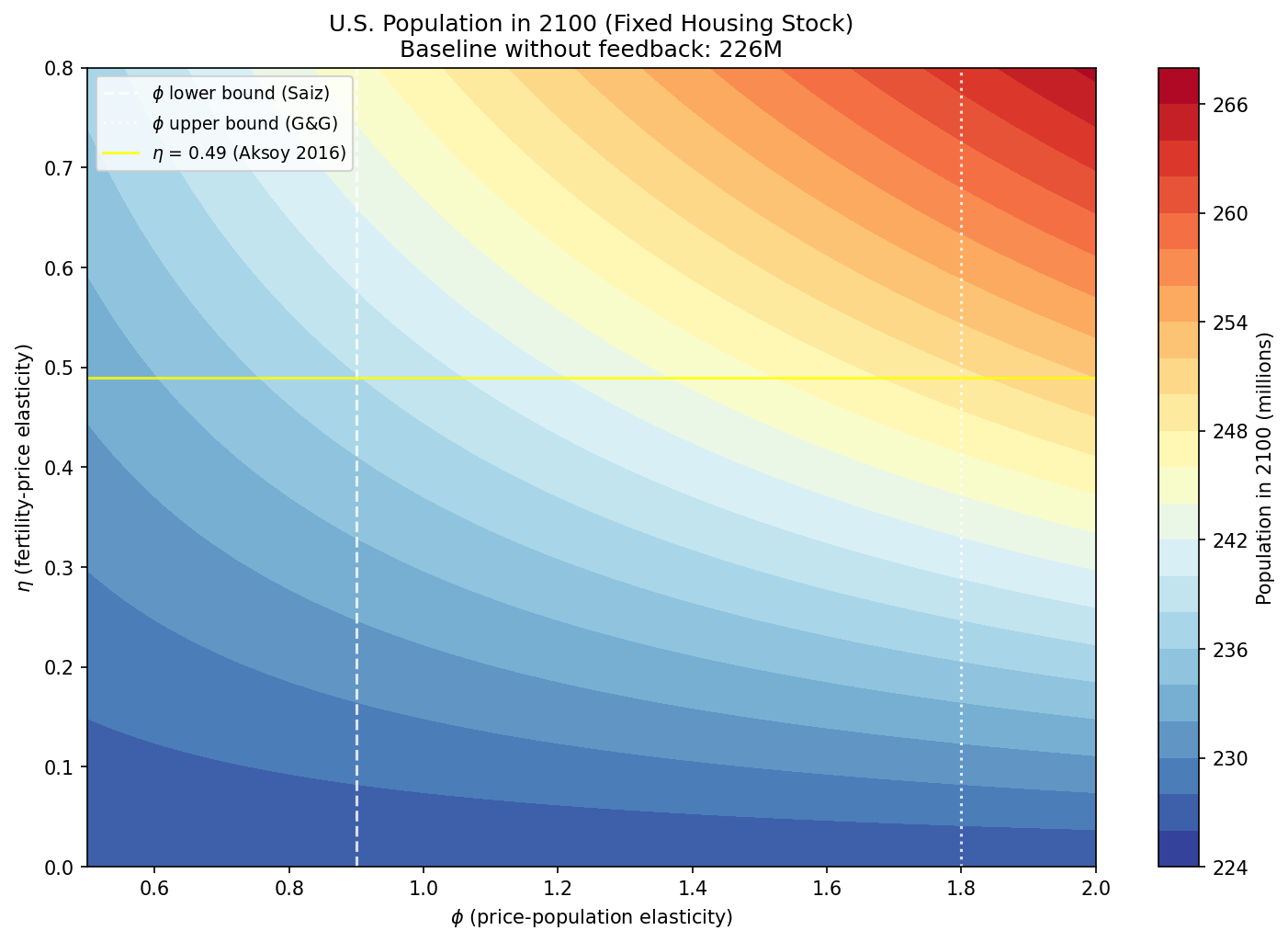
We can visualize the tradeoffs in the parameters like this. If you believe the elasticity is lower, simply put a pencil up to the screen and see the regions it crosses. There is also this, for seeing the differences between different scenarios.
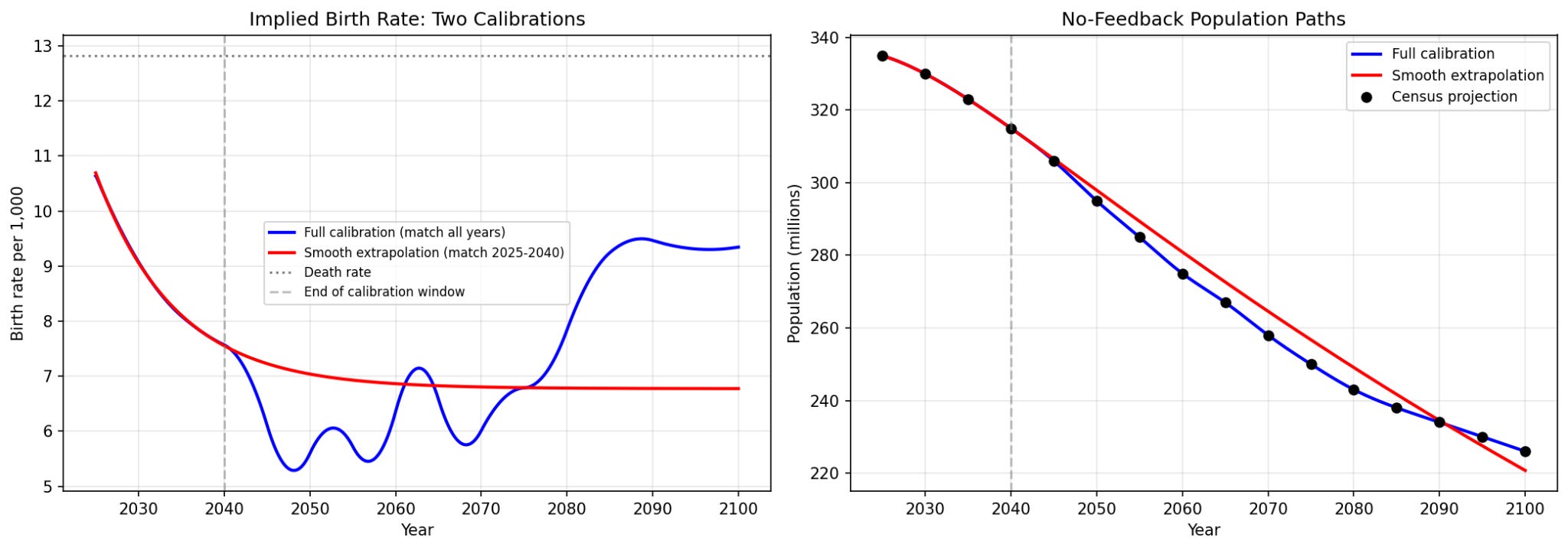
Something I was concerned about is the calibration. In the original, we matched each moment of the Census Bureau population projection, and so wiggled the birth rate in a way that seemed frankly silly. However, if we just take the first 15 years, and match them by extrapolation, the results don’t substantially change – population with housing feedback is 4-9% higher.
Am I confident in the exact numbers? No, of course not. The economy is very complicated, and projections are hard. What should or should not be in the model is a matter of taste, and does not have objectively correct answers. What I would like us to take away from this is how ad-hoc population projections are. They are not trying to model the primitives which drive the system, but rather assuming that everyone will converge to some TFR rate with no reason for this.
It is possible that AI makes all of this irrelevant. Matt Yglesias is right that every article kinda just becomes contingent on AI progress. If the world continues on in a way that is recognizable to us of today, though, then fertility is of extraordinary importance. More people means that we can get more ideas and more people working in research. Population projections which are based upon nothing more than the drawing of log-linear lines can mislead us, both positively and negatively. It would be a socially useful research agenda to continue chipping away at this, as I hope to. (This should slowly turn into a paper!)
I would like to thank the fine folks at Anthropic AI for making this possible. It’s insane how much faster it made everything go. This is not sponsored, I am simply in awe of their product.
I think your assumption that housing supply won't change to be flawed in some ways.
First and foremost, housing needs maintenance, so population decline will cause a shift in supply.
Second of all, population decline causes more people to move to cities, as rural communities become unsustainable to live in .
You can see this in Japan, and in Italy.
Housing in the countryside is very cheep, extremely so in the case of Italy, but if no one wants to live there, I fail to see how it will cause increases in fertility.
>> More people means that we can get more ideas and more people working in research.
I sort of really doubt that particular premise. Like, if we have 4x the population doesn't mean we get 4x Einsteins. And if we do, most probably only one of them is going to make a breakthrough - the other three will remain unknown, as there's only so much breakthrough surface where a major change can be made. Hells, it's even possible he's gonna make LESS, not more breakthrough, because in order to get to the place where he's heard, he's gonna spend much more time on elbow work.