
A standard concern with unemployment insurance is that we’re simply subsidizing lazy bums. If you pay people to be unemployed, they are unemployed longer. If we think of the worker as drawing a wage from a distribution, and choosing whether to take the job or search again, paying people for being unemployed will cause them to search for too long, longer than is socially efficient. We must therefore be clear about why unemployment insurance exists – it is to overcome the liquidity constraint which workers will face. Insurance is fundamentally a temporal reordering of borrowing – rather than borrow to pay for when a bad thing happens and paying it back later, you agree to borrow in advance and start paying immediately.
We can therefore think of the increase in unemployment duration when we increase benefits as being due to two different channels – one moral hazard, which is inefficient and bad, and the other a liquidity effect, which is efficient and good. If you want to calculate the optimal unemployment insurance benefits and duration, then Baily (1978) and Chetty (2006) showed that you only need to know three things. You need the elasticity of unemployment duration with respect to benefit generosity; you need the difference in consumption between employment and unemployment; and you need the coefficient of relative risk aversion. The consumption drop is bad precisely because people are risk averse, and want a smooth flow of income over time. If you get those three, you can spit out the correct benefit size (though not, I should note, the duration).
However, in practice, measuring these is actually surprisingly tricky, in particular risk aversion. As many people have noted (but see Chetty (2006) for a particularly elegant demonstration) estimates of risk aversion in different settings get extremely different answers. In particular, the coefficient of relative risk aversion comes from people having declining marginal utility of consumption. If you ask people in lab experiments about gambles, you’ll find that they’re really scared of risk, but if you observe people’s labor supply response to income changes, you’ll find things which imply they’re really risk tolerant.
To get around this, Chetty (2008) proposes using sufficient statistics. We can decompose the increase in duration into the unemployment and liquidity effects by seeing how much the job searches of those with assets and those without assets differ. Let’s say that the job-seeker can choose their level of effort. Therefore the effect of benefits is the change due to the cash grant, minus it raising the cost of taking a job. We get the effect of unemployment insurance benefits on search through cross-state variation, and we get the part which is liquidity from both the correlation of assets on hand with search, and also the receipt of severance from the prior job. With those in hand, if the ratio is larger than one, then we should increase benefits. Chetty (2008) cannot tell you what the level of benefits should be. He can only tell you whether they should be higher or lower, which is a real restriction – but it is, at least, measurable with data any organized state should have on hand.
This is all very elegant and beautiful. There is a reason why, though this is not a ranking, Chetty (2008) is first on my list of 100 papers that inspired wonder within me. (It simply came to mind first!). However, there is a big puzzle – there is a contradiction between what the model implies, and what we observe in reality.
Specifically: if unemployment insurance allows people to overcome liquidity constraints, then randomly assigning unemployment benefits should lead to the people who receive them getting higher wages upon reentry into the labor market, relative to their similarly situated peers. This will hold true, in fact, whether or not them searching for this higher wage is optimal for society.
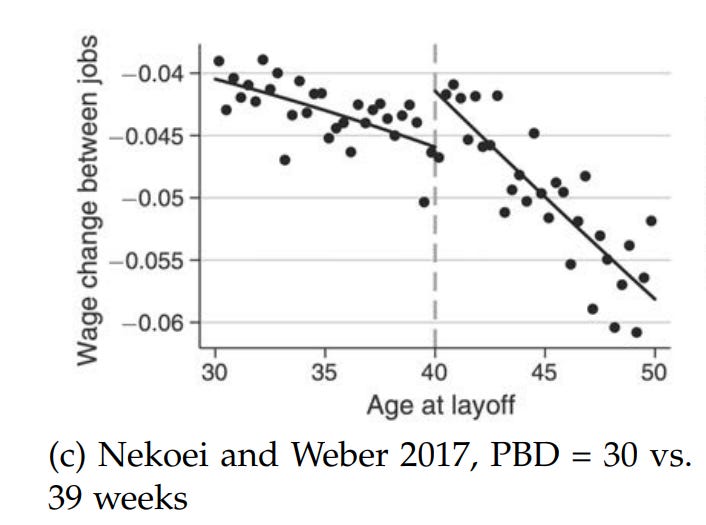
Yet that is now what we see. There is exactly one major paper (Nekoei-Weber, 2017) which shows a positive effect of unemployment benefits on wages on reentry, and it is small. Others do not find this. Annoyingly, most of these studies do not revolve around changes in benefit levels, but around changes in duration eligibility, but they should get after the same questions.
Nekoi and Weber use a regression discontinuity design. This is the standard in the literature – for their specific paper, in Austria, people who are older than 40 at the time of the layoff get 39 weeks of benefits instead of 30 weeks. If you assume people who are 39 years and 364 days old are very similar to those who just turned 40, then a jump in outcomes can be interpreted as due to the policy. A picture, though, is worth a thousand words, so here is the main graph. You can see the jump right at 40, even though older people tend to face a much more adverse labor market in general.
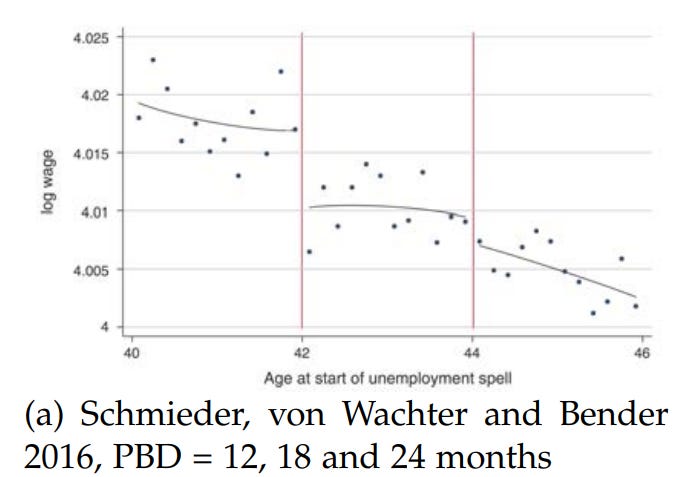
However, that’s not everything. Lots of studies don’t find the effects one would presume would be there. Schmieder, von Wachter, and Bender (2016) find what should probably properly be a null result, or at least a smaller negative result than what they find. (The econometrics literature is emphatic on this – do not use higher order polynomials in a regression discontinuity. If you do, then you can get very large differences in apparent outcomes due to changes far away from the boundary – imagine if someone on the border of 44 flips the quadratic upside down, completely reversing your result!).
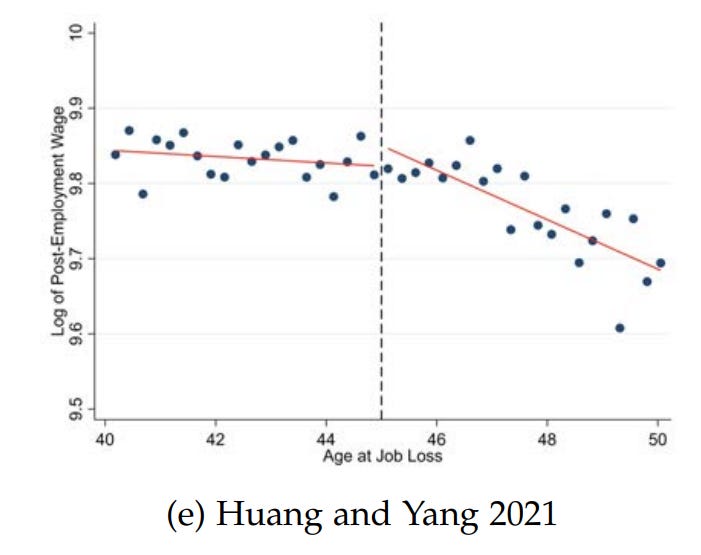
Similarly, Huang and Yang (2021) find no effect on wages upon reentry using Taiwanese data.
It may be possible to reconcile these results, as suggested in Nekoei and Weber (2017). Suppose that people’s skills depreciate the longer that they are unemployed. Greater benefits will raise the reservation wage and cause the worker to look longer, but if the depreciation of skills is greater, then wages will actually fall. This should be especially important when you’re using duration eligibility as the variation.
However, this runs badly into Schmieder, von Wachter, and Bender (2016). Having more future benefits should raise the reservation wage of job searchers, such that they would require a higher wage to forego it. Yet, conditional upon the duration of unemployment, there is no such positive effect on wages. Nor is it enough to say that that is because workers anticipate their human capital depreciating – if so, then there should be no impact on duration, but there is.
We do have a paper directly addressing the effect of unemployment insurance on the reservation wage, in Le Barbanchon, Rathelot, and Roulet (2019). In France, people have to report what the minimum wage they would accept for a job. In 2009, France got rid of the kinks in the mapping of tenure at a company to benefit duration, so you can exploit the heterogenous changes in exposure. They are able to rule out any change in reservation wage with an extremely narrow margin. What changes there are are coming through changes in search intensity.
This still means that unemployment insurance can be good. Plausibly search intensity has increasing, convex costs, and there is still definitely a drop in consumption upon becoming unemployed. We should just be careful in the stories we tell about Chetty (2008), as I have not been myself in the past – the liquidity channel is not necessarily just about allowing people to find the “right” job. That is a plausible intuition for it, but the empirical backing isn’t there. Instead, it is likely purely about smoothing consumption over time.
Finally, it’s kind of nuts to me that we are not out there experimenting all the time about what the optimal unemployment insurance benefits are. We have very, very little knowledge about the optimal benefit levels, for the simple reason that there isn’t much plausibly exogenous variation. The studies on duration are simply not portable except as analogies to the question of levels. Why do states not run experiments?
The only study I know of that addresses levels besides Chetty (2008) is Landais (2015). His argument in the paper is that changes in benefit duration affects your expected wealth, but not your moral hazard, while changes in the level affect both. Now, changing the duration does actually affect your search behavior, so it causes moral hazard, but it does so less and in a way that can be corrected for by having the agent solve an Euler equation. The identification comes from kinks in the benefit schedule – if there is a cap on max earnings, then people get a sharp change in marginal return to having worked, and likewise for max duration. He estimates that the moral hazard is larger than the liquidity channel.
It’s very clever, but relies upon agents who are able to solve their optimum path of consumption over the future without being biased toward the present, is underpowered because a change in slope (a kink) is going to induce much less variation than a discontinuity would, and uses data from 1978-1984, which may be of only limited relevance today.
Again, I have to say: we need more experiments in unemployment insurance. The current system is calcified – states will leave their codes staying exactly the same, never updating the taxable wage base for inflation – for decades. It seems highly improbable that we have happened to land upon the optimal schedule of taxes and benefits for all states – can’t we do better?
The critique I've always read of unemployment insurance is that the "pay more the more you lay off" tax structure is a poor fit for highly cyclical industries, and in particular has a negative impact on the construction industry.
> Yet that is now what we see
Classic now/not typo, I think.