The Great Recession
57 questions and answers about the causes of, and solutions to, the Great Recession

This essay is my accounting of the causes of the Great Recession. It will be necessarily episodic, and presented in the form of a catechism. Before we get lost swimming in details, here is the thumbnail version of my views:
The primary cause of the Recession was the shock to mortgage valuations blowing up the collateral upon which the financial system relied. These securities were the foundation of an unregulated banking sector, and when the valuation of the securities was called into question, the unregulated banks folded.
When these quasi-banks folded, aggregate demand fell, and we reached the zero lower bound.
Using the tools it had available to it at the time of the crisis, it is not at all clear that the Federal Reserve could have prevented the banking collapse or the shortfall in aggregate demand. However, quicker action would have reduced the severity of the crisis.
The financial crisis could have been substantially reduced by actions the Treasury could have taken before the crisis, namely producing more safe assets to serve as collateral.
Nominal GDP targeting would have been an improvement over inflation targeting, but it is difficult to think that it could have been implemented during the crisis. In particular, I do not think that Congress would have accepted the necessary inflation.
A recession of some size was going to happen anyway.
A shock to the expected returns of AI poses little danger of a recession along the lines of 2008.
This essay is very large. For your convenience, I will be adding links to sub-sections after the post goes live.
And before we begin, this post is brought to you by Mechanize, Inc. They are hiring software engineers to train the AIs of today to automate the work of tomorrow. Apply here today.
What does finance do?
Finance is fundamentally about making trades across time, and rearranging consumption in different states of the world. Let’s think through what a bank does. They solicit deposits of currency from depositors in exchange for paying interest, and then make loans to borrowers at a higher interest rate than what they are paying the depositors. These loans are into projects which take a long time to come to maturity.
What keeps the individual from making these trades themselves is that they face unexpected shocks in the future. They might have their car break down, or perhaps they would like to buy a bicycle. They cannot recall their money from someone who has taken out a loan to build a house and profit from 30 years of renting. By pooling money together, the bank can give people the ability to recall their deposits at any time. This also means that a bank can lend out more than it has at any given time, knowing that they will never be called upon to provide it all at once.
Is this unstable?
In practice, no, but in theory, yes. Suppose that everyone has common knowledge of the state of the world. Everyone knows that the bank can pay its obligations if only a few people call upon their deposits, but also that if too many people called upon the bank’s reserves, only the first people there will get anything. The bank cannot recall the loans before the projects which they are invested into are ripe. Grant that something changes in people’s beliefs. If people believe that the bank will fail, their best outcome is to go to the bank now and get their deposits before they lose everything. Thus, whether a bank exists is entirely determined by people’s beliefs about whether the bank will continue to exist. Diamond and Dybvig (1983) are the ones who formalized this model, but the basic intuition has been known for ages.
How do we keep this from happening?
The first thing is to realize the model is a bit too strong. Common knowledge, which means that not only does everybody know everything, everybody knows that everybody knows everything and so on, is an assumption with unrealistic implications. If common knowledge actually existed, then we would not observe any trades at all, besides those needed for liquidity. (Intuitively, Milgrom and Stokey (1982) points out that making an offer to buy or sell reveals private information you have about the payoff of the asset, which discourages one from actually accepting the deal).
Still, though, a bank run is a serious concern. And that’s why the federal government, through the FDIC, offers insurance on bank deposits. By guaranteeing that you will be made whole in the event that the bank collapses, we remove the incentive to be there first, and thus remove the incentive to collapse a bank. This has essentially made bank runs by retail depositors who are covered extinct. Even before the FDIC, though, banks were not helpless. A panic could be stamped out by the major banks using their credibility to take on the distressed assets, picking through what is good and bad, and lending freely to solvent firms, against good collateral, at high rates, in the words of Walter Bagehot.
The best empirical work on bank runs – Emil Verner is making a career out of this, see Correia, Luck, and Verner (2026), among others – is pretty conclusive that complete nonsense runs don’t really happen. Runs happen when the bank makes bad investments which were going to fail, and leave it unable to pay its creditors. Still, you can have real destruction in pulling back the loans too early. The ideal is to have the insurer take control of the bank quickly, and then unwind in an orderly manner which preserves as much value as possible. If a company has to sell in a hurry, then they can hardly be expected to get the full value from their assets.
How does finance work for large institutions?
Basically the same, except they don’t necessarily work with entities which are necessarily called banks. Suppose you are a large company with hundreds of millions to billions of dollars, which you use to make payroll, buy materials, and so forth. You can’t deposit the money into a bank, because the FDIC only insures up to a certain amount per account holder per bank. Instead, you must construct something like it, through a repurchase agreement.
What’s a repurchase agreement?
You, the large company, would like to invest your money in assets which take a long time to mature but pay a higher rate, such as in corporate bonds or a mortgage backed security. You cannot get a traditional deposit, but you can make something like it. The company gets (to put real numbers on it) $100 million in securities from the dealer (the bank), in exchange for the company giving the dealer $99 million in cash. This is held overnight. Come morning time, the dealer is obliged to repurchase the securities for $99 million in cash, plus some interest. The difference between the cash lent, and the value of the securities, are called the haircut. You withdraw currency by declining to roll over the arrangement in the morning.
How large was this form of credit provision?
Bigger than normal banks. These shadow banks, according to Pozsar, Adrian, Ashcraft, and Boesky (2012) provided about $22 trillion in financing at peak in mid 2007, although nobody knows the precise number.
What is a mortgage backed security?
A mortgage backed security (an MBS) is a bundle of loans to home mortgages. The idea is that the risk of default for a mortgage is independent of the risk of default for other mortgages. By combining partial claims to thousands and thousands of mortgages, you can create safe assets out of risky ones. What’s more, even if you were concerned about the safety of the asset, you can divide up the claims by priority. The senior tranches are the ones who are paid first out of a given bundle of loans, and should be rock solid, AAA rated assets.
Why did people want them as collateral?
People had an enormous demand for safe assets to make repurchasing agreements work. People needed assets that had economic value, but required them to know nothing about the actual details of the asset.
I should emphasize that mortgage backed securities made up only a part of the wider universe of asset backed commercial paper (ABCP). These are purposefully opaque
Wait, really? Why would people not want to know the value of the collateral?
Because eliciting that information is costly, and the payoff to knowing the exact quality of the collateral is flat. All you care about is that it is good enough for someone not to renege on the deal. Doing the evaluation once, and then never again, is what is efficient.
This idea comes from Robert Townsend (1979), but received its most forceful exposition by Bengt Holmstrom (2015). Debt is very different from equity markets, like the stock market. There, your payment is determined by the underlying value of the company. Acquiring more and more accurate information about the state of the world allows us to allocate capital to better uses of it. In the case of debt, you don’t get a penny more for discovering exactly how much the company will make, so long as it does not go bankrupt. The ideal is to exchange pooled long run assets for pooled short run assets, which neither borrower nor lender has evaluated for quality. In fact, if you own assets and wish to trade with them, you want to keep yourself from having the possibility of knowing what your assets are worth. The possibility of knowing more about the payoffs of your own assets makes you worse off because everyone suspects you might be trying to rip them off.
People got their securities rated by one of the rating agencies, and that was the end of things.
Who rated the bonds?
Moody’s, Standard and Poor, and Fitch.
And who issued them?
There were two groups of issuers: on the one hand, the government sponsored enterprises Fannie Mae and Freddie Mac, who bought conventionally sized and underwritten loans, and on the other hand, private label issuers, who securitized everything else. Fannie Mae and Freddie Mac are strange organisms – Fannie Mae was originally set up as a government agency in 1938, then spun off into a quasi-private organization in 1968 (with Freddie Mac created two years later as “competition”). The motivation for this was that they wanted the agency off of the federal budget because it looked bad – see page 104 here – but in practice people treated it as still guaranteed by the government.
This is a pretty bad state of affairs! Fannie Mae and Freddie Mac understood their position, borrowed at rates nobody else could get, and were heavily levered. It produced profits by shoving all its risk into the tails. Then when things blew up, it took the involvement of the government to keep them from taking the economy with them.
Who was buying all these new mortgages?
The expansion in mortgage credit was broad-based. Contrary to the popular narrative, this was not just about subprime mortgages – if you go by the value of the loans underwater, high and middle income borrowers were just as important.
How important was actual fraud in mortgage issuances?
Important, if not as important as people think. Like there was definitely a lot of it going on – Piskorski, Seru, and Witkin (2013) found that a tenth of loans were misreporting either whether the owner was the primary occupant and/or whether there was a second loan with the house as collateral – and with the mortgages bundled off into securities and out the door, there was little incentive to check. Nevertheless, the rise in housing prices was broad-based enough that it was not simply about fraud.
How should certification happen in a financial market?
The idea is that the firms acquire a reputation for soundness and plain dealing which makes their claims trustworthy. But the trouble is that this need not hold when the risks are rare but enormous, and the amount that the rating agencies have at stake is limited. Competition, in the form of the entry of Fitch, led to ratings actually getting slacker. (Becker and Milbourn, 2011)
A substantial part of what certification is doing is not for the benefit of actual investors, but to meet regulatory requirements. Frank Partnoy (1999, 2006) was warning about this long before the financial crisis – the point of an AAA bond rating is to get the bond in the door, and allow you to do things for which no one is responsible for with other people’s money. I think this is only partly true, because
I am roughly in favor of getting rid of shopping around for ratings. If someone wants an asset rated, it’s assigned at random to a qualified firm, and you live with what it says. This was proposed in the aftermath of the Great Financial Crisis, but scrapped. For complicated assets, people simply shouldn’t treat the credit agency rating as definitive, and should just not treat it as money.
Was there a bubble?
Probably. But it’s going to be observationally equivalent to some other things.
What is a bubble?
It is not, to be clear, simply any time that prices were high and then fell. For instance, it is not a bubble if there exists uncertainty over the future development of a technology, and we happen to get bad luck.
How is it possible to have a bubble?
This is a serious question. If we make the innocuous assumption that people prefer more to less, and are not actively trying to lose money, it’s pretty difficult to justify. If the game has a known number of periods, somebody’s gonna have to be holding the bag at the end; knowing this, people will choose not to get involved. At best, you break even on average, and if you add in the slightest bit of risk aversion or declining marginal utility, the utility from getting involved is negative.
There are two basic ways to get a bubble, one with rational agents, and the other with some number of irrational agents. The rational agents are pretty striking and clever, and have a similar root to dynamic inefficiency in an overlapping generations model. You have agents who are born, work, retire, and die. They can save at the interest rate r, and the economy is growing at the rate g. If r is less than g, then the economy is growing faster than private savings are, and it would be efficient for us to fund people’s retirements through taxes on labor income now. We’re essentially changing our savings from a worse to a better vehicle.
A bubble, which is an asset which grows at the growth rate of the economy, is something which sops up capital until r equals g. A bubble, then, can not only exist, it actually improves outcomes. The reason it doesn’t happen by default is that no one is incentivized to start the chain of transfers – but if the system came into being that way, or in the case of Tirole (1985), the bubbly asset started out that way, we would be better off. Perhaps you think that this is silly. But then, what is the fundamental value of money?
(Why must it start that way? Because if people expected a given asset to become a bubble, the expected value must be greater than the fundamental. If it is trading at the fundamental value, then people must never expect it to be a bubble. QED.)
These rational bubbles were likely not what’s going on, though. Housing prices were appreciating much faster than the interest rate. More likely there are some people who are just plain wrong about prices. We don’t necessarily need to know why they’re wrong – perhaps they’re just enthusiastic about the economy doing well. If this is the case, then a rational agent might want to play along with the bubble, and sell before it runs out of rubes. We need one more ingredient to make a bubble – some inability of arbitrageurs to bring the price down independently. Abreu and Brunnermeier (2003) is one such story – people know that there is a bubble, but they don’t know when other people learned that they are in a bubble. Thus, you want to play along.
How do we know that we’re actually in a bubble?
So I will grant that it is very easy to say that a bubble can exist. It is very hard to say that any particular rise in asset prices is a bubble without making a fool of yourself when the prices stay high indefinitely. We should be clear that there being a bubble in housing does not mean that all housing prices in all parts of the country were inaccurate. Indeed, housing prices are higher now than they were then, driven by appreciation in the supply constrained coastal metros, like New York City and San Francisco. Rather, we must argue that there was a bubble in housing in some part of the country.
The best case for us being in a bubble is that rent growth became detached from price growth, including in cities where it would be very easy to buy more housing. When you asked them, people expected prices to just keep on growing. Kaplan, Mitman, and Violante (2020) argue that changes in objective credit conditions did not explain the boom in housing, but changes in beliefs did. (Their argument is that if people are limited by credit from buying the living conditions they want, they will instead rent. Removing credit constraints results in people buying instead).
Couldn’t mortgages just have been a good bet, just bad luck?
I would argue that that is not what happened. Certainly it could explain the early 2000s dotcom crash, which I do not think was a bubble. You do, however, raise a good point. The exact form of the sudden price decline is not that important. What matters is leverage in the banking system, whether formally or informally a bank.
Why does this matter?
The mortgage backed securities were being extensively used as collateral. The whole class was correlated with each other. When the value of the mortgage backed securities fell, companies were now uncertain about the value of the things they’re buying in the repurchasing agreements. Indeed, they expect the dealer to know better than them which securities are good and bad. They leave, or demand a larger haircut.
The dealer, being a bank, is leveraged. They have borrowed extensively to conduct this operation. They cannot pay everyone at once, not until the securities they own mature. They must liquidate their holdings, and liquidate now. When they are forced to sell, they have to sell below the real value of the assets, because the people who are able to actually value the securities are the ones who have to sell.
Do all losses in value cause a financial crisis?
No, and the difference is in how levered companies are. Enormous decreases in value have come and passed without a crisis – in a single day in October, 1987, the Dow Jones declined by 22% without any discernible impact on the real economy. The tech boom had fallen just a few years ago in 2001, with the only fall in output coming from realizing that the tech wasn’t going to be as good as advertised and cutting back on spending. If there is no borrowing – if the assets aren’t being used as collateral – there’s no crisis.
Why is a financial crisis bad?
So we wake up one morning, and there’s bad news about the economy, large enough that we begin to doubt the worth of our collateral. The clock is ticking – if we roll over our deposits to the next day, but everyone else doesn’t, we’ll be left holding worthless assets and out millions of dollars. So we decline to rollover, something essentially costless to us if we’re the only ones doing it, and the best we can get if everyone else is.
The dealers were highly leveraged. Bear Stearns and Lehman Brothers, when they collapsed, were operating at 30:1 leverage. With their usual parties backing out, they need to get money and get money now. They start selling off assets, but since nobody has had time to evaluate the quality of the assets, they go for prices well below what they’re worth. That’s the fire sale.
The fire sale propagates outwards, because other people hold those assets too and use them as collateral. Now that the collateral is worth less, people need to get more cash, which they get by selling their bonds, again at progressively lower prices.
All of this was being used as money. Nominal GDP, which is price times output, must equal money times velocity, where velocity is the number of times a given dollar bill is used during each period. Now that all these loans are winking out of existence, velocity is falling. There were fewer dollars available to spend on goods and services. Either prices or consumption must fall, and since prices did not fall enough, real consumption and employment fell. But more on this later.
It was confusing to people at the time that what we conventionally call “money” – currency, bank deposits, etc – did not fall during the crisis, and in fact grew at a 5-10% annualized clip throughout. The fall in aggregate demand was due to money like objects, the asset backed commercial paper, which collapsed. Nominal GDP fell by 4%.
Why, exactly, is a fire sale externality an externality?
It’s certainly a bit weird, because things which occur through prices are not usually externalities which we care about. An externality, incidentally, is a cost or benefit which falls upon someone who is not party to a transaction.
Parties hold assets as collateral, and how much they can borrow is related to the value of that. How do we value it? Well, we must consult the market. If someone is selling AAA mortgage backed securities, same as the ones you hold, for well below their fundamental value, your collateral has lost value and you too must start selling to get cash to unwind your position. It spreads from person to person.
Can you give me a chronology of what happened and when?
I have been shying away from this, because there is simply so much detail that presenting all of the events would boggle the mind and impede understanding. To my mind, the principal events are these:
– National housing prices peaked in the middle of 2006, and began falling.
– More and more people started defaulting on their mortgages. On August 9th, 2007, BNP Paribas said it can’t value holdings of subprime mortgages in three funds, and halted withdrawals.
– In March 2008, Bear Stearns collapsed. This was handled by JPMorgan buying the company, and the Federal Reserve guaranteeing part of the assets.
– On September 7th, Fannie Mae and Freddie Mac were placed in conservatorship, where they have remained ever since.
– On September 15th, Lehman Brothers collapsed. AIG, which was in danger of collapse, gets bailed out with a ton of money. This is, properly speaking, the financial crisis.
– Output collapses. GDP fell 2.2% in the fourth quarter of 2008. (That’s 8.4%, annualized). The Troubled Asset Relief Program, which was $700 billion to recapitalize banks, passed October 3rd.
– In February of 2009, Congress passed an $800 billion stimulus bill. The recession ended in June of 2009, but unemployment would peak at 10% in October, and employment did not go back up to the level it had attained before the crisis until 2014.
I want you to understand that this was a crisis which happened slowly, then all at once. Employment started falling in 2007, well before the collapse of Lehman Brothers. Still, the big slide in output and unemployment occurred after the financial crisis.
What is the Federal Reserve?
The Federal Reserve is a unique government organization. It was created by statute as a consortium of the major banks in 1913, formalizing the role that those banks had in preventing panics previously. They would step in to act as a lender of last resort, propping up sound business in order to prevent the collapse of the system.
What does the Federal Reserve do now?
The Federal Reserve manages the money supply of the United States. This is a relatively new development – before the 1960s or so they were much more of a consortium of banks in operational practice than a branch of the government held at arm’s length. They still do do bank regulation.
The Federal Reserve is in a policy regime of inflation targeting – they want the price level to increase by two percent every year.
How does the Federal Reserve do it?
Notionally, it uses the tools available to it to manipulate the money supply. More on that later. But fundamentally, the power of the Federal Reserve is that it selects the equilibrium we are in. There is a lot about the Fed which is driven by people’s belief in it.
What tools does it have?
The standard instrument is its control of the federal funds rate, and the rate at the discount window. The federal funds rate is the rate at which banks in the Fed lend to each other in overnight reserves. It used to be that they would change this rate only indirectly, by buying and selling treasuries until the rate matched what they said. (This works because the banks were required to meet the reserve requirement of having 10% of deposits on hand, and so banks would borrow from each other to meet the target at the end of the day). Now it manipulates the interest that it pays on reserves directly.
Interest on reserves was introduced during the Great Recession, incidentally, in order to give them more tools. Unfortunately, by hiking the amount that they were paying on reserves at the same time that they cut interest rates, they undid the rate cuts during the crisis meant to stimulate demand. It was rather like – I endorse giving the car a steering wheel, but that does not mean I endorse turning it into a brick wall.
The Federal Reserve can also lend directly to banks, at the discount windows. This option is not as powerful as one would hope, because everyone understands using this to mean that the bank is in financial trouble. There is a distinct stigma. When using the discount window is absolutely necessary, the Federal Reserve will often call the major players together, and tell them to all borrow from the discount window together, so that no one has to indicate that their position is weak.
In abnormal times, it can engage in quantitative easing. This is when the Federal Reserve buys assets for cash (reserves). The Federal Reserve cannot, as is normally conceived, simply print money. Quantitative easing is supposed to be swapping treasuries for reserves, which have well known payouts. The Fed did engage in buying mortgage backed securities, which while they only bought securities guaranteed by Fannie Mae and Freddie Mac, is still pushing resources to the housing sector.
If the Federal Reserve were simply printing dollars to buy assets, then it can always force changes in prices, and there’s really no question about it. If people don’t increase their prices, they will find themselves selling the shirt off their back for pennies on the dollar. If the Fed is swapping treasuries for reserves, though, it’s a bit difficult to see how this leads to higher inflation. Treasuries at the zero lower bound are essentially a perfect substitute for money.
There are two paths for this. The first is that it affects the duration of debt. A bond which takes a longer time to mature is exposed to the possibility that interest rates will change in the meantime, and we would have preferred to have bought a different security. This requires a premium. When the Federal Reserve buys long run treasuries and emits reserves, it gets rid of the interest premium and reduces the cost of borrowing. This is stimulatory.
The other is more of signaling. The Federal Reserve has the power to squash inflation by hiking rates again, even if it does not have the power to create inflation by cutting below zero. People will naturally be concerned that when inflation does rise, including above the target, the Federal Reserve will squash it down. Owning lots of treasuries means that hiking interest rates too early will be made more and more expensive.
This is really weird. Isn’t the Federal Reserve part of the government? Does it meaningfully face costs?
The interest rates it sets do ultimately affect how much the government will be paying in debt payments, which flow to people outside the government. If it hiked interest rates too early, it would have to stop remittances to the Treasury and it would look like it is losing money. The assumption is that Congress would get mad if that happened.
It just goes to show, though, that above all what quantitative easing does, when it is not fiscal policy in disguise, is try to coordinate expectations!
What happens if the interest rate is at zero?
Then we are at the zero lower bound. This spells trouble, because the Fed can’t cut. People will simply hold cash. Having settled down at zero, we might have a very hard time getting back up again.
Bad?
Very bad. Very, very bad.
Can you walk me through why?
The financial crisis happens. The wealth of households falls. We presume that they want some level of savings relative to future income, which is what their wealth is. The only way to build back up savings is to consume less and save more. The real interest rate, which is what it costs to consume now in exchange for payment later, can fall negative. Savings exceed desired investment at the market clearing price. The Federal Reserve cannot lower the interest rate anymore in order to clear the market, so what must fall is total output and total consumption.
Making it worse, people rationally expect this condition to last for a while, which is what makes it actually last for a while. Because they expect lower spending in the future, they cut their investment and increase savings now, which further decreases demand. When we are at the zero lower bound, there’s no reason to expect a shortfall in aggregate demand to get better anytime soon, and we can have a persistently sluggish recovery – as indeed, we saw.
Why don’t prices and wages simply change to accommodate the fall in the money supply?
That’s what we’d expect, but this need not hold at the zero lower bound. We would expect money to be neutral in the long run, and indeed, under some circumstances we would expect it to be perfectly neutral in the short run. If the Federal Reserve went out and said “tomorrow, all quantities of money are going to be ten times higher, add another zero to the end of it” and this genuinely applies to everything in the economy, without a being a trick of some kind to get out of debt, I would expect this to have a minimal effect on the economy. Everybody just adds a zero, and we get on with things. Less fantastically, countries have been able to switch over to new currencies without much fuss, and the UK was able to switch over from pounds-shillings-pence to decimalized currency without causing a depression, so we cannot always expect changes in the quantity of money to matter, and certainly not forever.
This intuition falls to pieces at the zero lower bound. The financial crisis cuts money supply (demand), and prices and inflation fall. The interest rate is stuck at zero, so falling inflation actually raises the real rate of interest, further discouraging investment. An example. The real interest rate is simply the nominal interest rate minus expected inflation. The nominal interest rate is at zero. Expected inflation is also zero. Thus, the real interest rate is zero. If the amount of money is expected to contract by one percent, then the real interest rate goes up by one percent. Things end only when the shock that is causing the contraction in demand ends.
Second, I think there are complementarities to people’s actions, both real and through aggregate demand, and that a crisis can lead to a shift in people’s beliefs and lower investment indefinitely. There are a number of broad strokes models consolidated by Cooper and John (1988) on how we could be at less than optimal output because of a crisis of confidence in what other people are doing. The key is that there have to be increasing returns in some way.
We get out of a zero lower bound by, somehow, having people believe that inflation is coming. If we have fiscal powers, this is easy. We just buy real assets. If people don’t want their assets bought for a fraction of their value, they will raise prices. If we are constrained to monetary policy alone, then we need people to believe that prices will rise. We do this by credibly promising that we will run inflation hotter in the future.
What could we have done to prevent it?
This question branches out in a few ways. The first path is things we could have done before the crisis, in particular with mortgage backed securities. We’ll return to that. The second path is what the Federal Reserve could have done in the crisis, and this too divides up into two paths: we can change the Fed’s actions, and we can change the Fed’s regime.
The first path involves cutting earlier and harder. I do not think that this prevents a recession entirely, but it definitely prevents it from being a Recession. There are a few points at which they should have acted, and what’s more, should have acted with the information they had.
I can partially excuse the summer of 2008, because their data was bad. Inflation was 5% in 2008, while output seemed to be normal. I note that it seemed to be normal, because it later got revised down to better match the facts. There were warning signs, though. The financial markets, in particular, were positively screaming that things were not right. In particular, the gap between LIBOR and OIS widened, and stayed wide. LIBOR, the London InterBank Offered Rate, is the rate at which banks are willing to lend to each other unsecured; OIS, the overnight indexed swap rate is a promise between two parties, one of whom pays a fixed rate, and the other pays the federal funds rate. The spread between the two is basically the value banks put on not having to actually hand over assets to make a trade. For it to be up and stay up indicates an enormous breakdown in trust between banks.
What was absolutely inexcusable was September 16th, the day after Lehman Brothers collapsed. The Fed met in a regular meeting, and chose to hold the federal funds rate at 2% rather than cutting. When it finally did cut rates, on October 8th, 2008, it was too late. Even when it did so, in October, it introduced interest on reserves at the same time, offsetting what it was trying to do with rate cuts. By December, rates had fallen to 0, but it was too late.
Interest rate cuts are rather like balancing a pole on your hand. It is necessary to exceed the amount that it is falling in the opposite direction, and once it has fallen you cannot start again without picking it back up. To do that, you need to change the regime.
What do you mean by changing the Fed’s regime?
The regime is a term of art in macroeconomics. It more or less means what goal the Fed is aiming for. If it’s aiming for a 2% inflation target, then the regime is how it is going to respond to real shocks. We can’t confidently port empirical results from one to another, not unless we have built why people do things out of their underlying utility functions.
An alternative regime, which I think gets resorted to de facto at the zero lower bound, is nominal GDP level targeting, or NGDPLT.
What is NGDP level targeting?
NGDP targeting is the idea that the Federal Reserve should not target a rate of change in the price level, the inflation target, but instead target a level of nominal gross domestic product (or NGDP). This is the nominal value of all final goods in the economy. The central bank proposes to reach some level of NGDP in each period, and if it fails to do so, to make up what was missed in the next period.
The point that I want to make, in as forceful a tone as I can express through the written word, is that a credible promise to run inflation hotter in the future, which gets us out of the liquidity trap, fundamentally is NGDP level targeting. A pure inflation targeting regime has two steady states, one where we are at the targeted level of inflation, and one where we are the zero lower bound forever. (Benhabib, Schmitt-Grohe, and Uribe (2001) are the ones who worked this out). We only have to believe that the Federal Reserve will follow its own rules forever. NGDP level targeting technically does have two equilibria, but having the economy stay at the zero lower bound requires that the Federal Reserve be completely non-credible about what it is going to do.
It’s important that we target the level, rather than letting bygones-be-bygones and restarting in each period. Otherwise it’s just a shadow of itself.
Are there other advantages?
Yes, and the biggest one is how we handle supply shocks. Nominal GDP growth is equal to real GDP growth plus inflation. Suppose that the economy is growing at 2% a year, and we are targeting a level growth of 4% a year, giving inflation of 2% a year. If the economy does unexpectedly worse than predicted, we look past this and have higher inflation in the period.
Two ways you can arrive at this. The first is that we don’t actually want to stabilize prices per se, we want to stabilize the prices which are sticky. NGDP turns into a proxy for labor incomes. You don’t get confused by oil spiking and bringing inflation with it, and thinking you need to cause a further reduction in employment to keep inflation on target.
The other is making a claim about the price changing process of firms. The standard device for modeling price changes in the economy is Calvo pricing, where some fraction of firms get the ability to change their pricing in each period. In that world, the optimal strategy is an inflation target (and at 0%), with the intuition that misallocation increases quadratically as we get away from the optimal price, and it is thus optimal to break a shock to one sector into a bunch of little distortions across all of the sectors. If firms face a deterministic cost to changing their prices irrespective of the price change size, as in Caratelli and Halperin (2025), then it’s best for shocks to one sector to not be shared across other firms, and instead have the price change be large enough for everyone in the affected sector to pay the menu cost to change their prices to optimum.
NGDP may also be easier to compute, although I think this is a minor advantage at best. To calculate NGDP, you simply sum up the value of all final goods in the economy. Calculating inflation requires doing this, then adjusting for changes in quality, then pulling out inflation as the residual. However, bias in quality adjustments is not actually important so long as it is the quality unadjusted prices, the nominal prices, which are sticky, as Schmitt-Grohe and Uribe (2009) show. This seems obviously accurate, and so I am not particularly concerned about inflation being that hard to measure for the purposes of monetary policy.
Do you just agree with Scott Sumner on everything?
Kinda! But where I disagree most is on futures markets. Sumner is particularly attached to using futures markets to actually guide Federal Reserve policy. I don’t think this can fully work, although it partly can.
Much of Sumner’s work, from the Midas Paradox on the Great Recession, to his blogging, has been basically to look at the financial markets right after the announcement of policy, and pull out the implied effect of the policy from the change in people’s beliefs. This is an incredibly powerful tool. If the Fed says that they are cutting rates by 25 basis points, and the stock market craters, it indicates that monetary policy is in fact tight, and they are not reducing the interest rate enough. So it’s natural that we’d want to pull the information from that. But we can only do that when everyone understands that the change in financial markets is not, itself, determining the course of monetary policy.
Consider the following model. The Federal Reserve creates a prediction market for NGDP. People can invest into finding information about the world, which causes them to buy and sell futures on the prediction market. But the Federal Reserve is just going to take this information, and change things so that, on average, the investors are as equally right as wrong. Nobody has any incentive to invest into finding information. The course of NGDP will be on average accurate, but with wild error bars in either direction.
Futures markets can be a part of making predictions. But, they must remain only a part. The Fed faces a time inconsistency problem. Suppose the Fed forecasts something internally, but the market disagrees that their answer will actually achieve the target. It must be incredibly tempting to simply change policy until the gap is fixed! But if you do this, you destroy the informational content of the predictions. This is why Bernanke and Woodford (1997) rejected using market forecasts of inflation long before the crisis.
What makes things worse is that the influence that the market can play in decision making has to be fixed. Suppose that investors pay fixed costs to discover information, in expectation of a certain amount of profit. If the Fed makes their prediction more accurate than expected, then rather than break even, traders actually lose money. I see Prof. Sumner’s proposal for guardrails, instead of exact targets, to be conceding this point. Basically you put bands around the NGDP target which are good enough, and people are still able to profit by placing bets, knowing that the Federal Reserve is not going to – or at least, it says it’s not going to – continue poking nominal GDP to be more and more on target.
I think it is telling that a similar instrument, which allowed you to bet on non-farm payroll, ended up getting delisted because of lack of interest.
Could we have switched to NGDP level targeting in the recession?
This is where I am also not so confident. On the one hand, people really, really hate inflation. Also, the Republicans had been attacking the stimulus, quantitative easing, and everything else the Fed was doing as dangerous government overreach and the first steps to hyperinflation. Peter Diamond, who is a genius, got his nomination tanked by Republicans because they felt that he would be too much of a Keynesian and too likely to allow inflation.
This is an unfortunate answer to me, because I want to separate out things which are impossible because they are physically impossible, and things which are impossible because politics is unlikely to allow them. Answering the latter is completely uninteresting. It’s tautological – it can’t happen because the decision makers would have to make different decisions – but the whole point of studying this is to inquire after what happens with different decisions. Nevertheless, it binds both our attempts here, but it will also likely bind our future attempts to prevent hitting the zero lower bound. The last potential crisis which might have caused us to reach the zero lower bound was Covid. We had high inflation after, because the Fed did not hike rates aggressively enough. This was incredibly unpopular, and substantially responsible for the reelection of Trump. If we have another deleveraging crisis, will the promises to have high and sustained inflation later be credible? I am not so sure.
Was the financial crisis a cause of the recession, or a symptom?
I am not convinced this is a conceptually sound question. So, the case for it being a symptom focuses on the summer of 2008, when market indicators for NGDP were falling. The Fed standing still is allowing a contraction to happen. As NGDP falls, loans which were previously good failed, and the financial crisis is a belated recognition of what has gone on.
Why I think the question is conceptually unsound is that indicators of falling NGDP are themselves including the expectations of a financial crisis. Thus, preventing the financial crisis is a different path to preventing the fall of NGDP.
Go back to the question of mortgage backed securities. Couldn’t we have prevented this if we had more safe assets?
I do not think we could have completely prevented it, but I do think that we could have substantially reduced the magnitude of the Great Recession and financial crisis.
The lead up to the Great Recession saw an enormous global savings glut, as Bernanke (2005) called it. The developing world – mostly China – was growing and needed somewhere to save their money, but China’s government was not trustworthy enough to buy debt in bulk. So, global investors gobbled up U.S. debt at a massive scale, and when that ran out, they turned to other securities. This is a problem, because the private sector does not take into account the firesale externalities they create when they produce money. Relative to the optimum, there is too much private money (Greenwood, Hanson, Stein, 2015, and Jeremy Stein, 2012)
The United States could have prevented much of this by having the Treasury create more bonds, then depositing them in the Federal Reserve in exchange for reserves. Doing this crowds out private money basically one-for-one (Krishnamurthy and Vissing-Jorgensen, 2015), which is pretty much exactly as I would have expected. The idea of making the monetary system run free by getting rid of leverage is an old one, dating at least as far back as the Irving Fisher endorsed 1935 Chicago Plan, and seems to be held both by conservatives like John Cochrane and liberals like the Harvard team.
It would not have prevented it entirely, because I do not think more treasuries would have fully prevented the use of mortgage-backed securities as quasi money. Some of the investors were after the higher yields of mortgage backed securities, and were shoving away the tail risk. This means that we probably get an unwinding of debts and a bunch of financial firms in the tank, but no systemic crisis. This also increases the odds that the actions of the Fed will be appropriately sized to the crisis at hand, rather than inadequate as it was in reality.
The best argument against is that the flow value can be used to fund things. This is by itself an upside, because it’s pure value, but the downside is that there might be spending obligations tied to it, which we are unable to adjust for political reasons when the facts change. The sovereign wealth fund of Norway, which is doing something conceptually similar, gives us a way to handle it, which is to have the rules for how funds are returned to the government be entirely driven by the returns of the portfolio, and avoid having it tied to a specific program.
To what extent did housing itself matter?
So there’s a literature on this that I would like to talk about – it is a question like this which gives away that I am controlling both sides of the conversation.
This line of literature is dominated by the work of Atif Mian and Amir Sufi together. Suppose that people have a desired level of wealth as a portion of their permanent income, of which their house is a substantial component. The value of their house drops; in order to have wealth return to the desired level, they need to consume less. This causes demand to fall, reducing output unless offset by the central bank.
The first part of the argument, Mian, Rao, and Sufi (2013), is spent establishing that there was an enormous response of consumption to the price of housing. When the value of someone’s house falls by one dollar, consumption falls by five to seven cents. (If that doesn’t seem like much, remember that the value of a house is spread over a long period of time, so this adds up to 60 to 80 percent of the net worth fall gets reflected in consumption). This response is even larger in zip codes which had a greater proportion of underwater houses or subprime mortgages. Similarly, Berger, Guerrieri, Lorenzoni, and Vavra (2018) find a considerable decline in spending where housing wealth falls.
We should be clear about why this is a bit surprising. A house has two things bundled in it – it is both a financial asset, and a place to live in. When the price of a house falls, that also means that the price of choosing to live there falls. Buiter (2008) puts it bluntly in the title – “Housing Wealth is not Wealth”. Nevertheless, once you add in credit constraints, you will get changes in spending. If consumers had the ability to offset by borrowing, this shouldn’t matter. Since they face credit constraints, it does.
We can then trace this fall of demand to employment. Mian and Sufi (2014) show that places which saw a greater decrease in demand had employment fall in non-tradeable goods, but there was no correlation with the fall in employment in tradeable goods whatsoever. The idea here is that the demand for tradeable goods depends only on aggregate conditions, but non-tradeable goods depend on demand in the local region.
We should be clear that employment fell in all sectors. We are not able to take these partial equilibrium estimates and trivially scale up to “this is the total explained by housing and aggregate demand”. What we can do instead is say something about what the shocks that mattered were.
Why does it matter?
It matters when we consider how monetary policy actually gets passed through to the individual. There has been a considerable change in how economics thinks about this in just the last few years. (For details at greater length than this, see my essay on Ludwig Straub). Previously, we assumed a representative agent, standing in for all consumers. The attributes of this representative consumer can be filled out by taking the average from the population.
Recently, however, we have begun to incorporate heterogeneity in the models. People differ in their income and wealth, and thus in their marginal propensity to consume. In a representative agent world, if we say that we are giving everyone a hundred dollars today, to be paid for by taxes later on, this produces precisely 0 change in spending. Everyone simply saves enough to offset the expected tax liabilities in the future, a condition called Ricardian Equivalence. This is too strong to hold literally in reality, although it is a useful reminder that expenditure largely depends on what people expect their total income over time is, not necessarily how much they have now. Our model should be changed to reflect this.
Now add in heterogeneity. Posit that some people have limits to how much they borrow. They want to be spending more now, but cannot – instead they might have illiquid assets that pay out in the future. When you have transfers, people do not all share the same marginal propensity to consume. Transfers to people with high MPCs are going to be much more effective than broad based fiscal stimulus.
Heterogeneity also completely changes how monetary policy reaches the public. In the world of representative agents, changes in the interest rate only reach the public through changes in the intertemporal elasticity of substitution. With heterogeneity, much of how monetary policy reaches the public is through actual changes in the economy, and not purely due to savings behavior. Kaplan, Moll, and Violante (2018) is the key reference on this. We have a distribution of people who hold mortgage contracts. They could refinance their mortgages by taking on a new loan at the new, lower interest rates. This reduces their monthly payment, so it’s effectively a transfer from the banks (who have a minuscule marginal propensity to consume) to the households (who have a very high MPC). The refinancing channel is an enormous way that monetary policy reaches the public, and households which are underwater on their mortgage can’t do it at all.
Beraja, Fuster, Hurst, and Vavra (2019) found that places with a greater fall in housing value, and more homeowners underwater on their mortgages, were less responsive to cuts in interest rates. Thus, the passthrough of interest rate cuts to the places which were going to see the biggest declines in aggregate demand was hampered, and we see a decrease in the purchase of consumer durables like cars at the same time.
What is the other story?
The other story of how the financial crisis gets to the real economy is that it runs through lenders to borrowers. There are banks which lend to firms. They suffer liquidity shocks, and don’t have the funds to lend as they did in the past. The firm is unable to meet its lumpy needs for cash, and has to contract its business.
There is evidence for this channel being important too, to be clear. Chodorow-Reich (2014) is a fantastic paper addressing this. He has data on the ties to banks for thousands of firms, and he has how exposed different banks were to mortgage backed securities. Since the lending relationship between borrower and lender is sticky, borrowers whose banks were plausibly exogenously more exposed to the Lehman Brothers collapse and its aftermath saw reductions in financing and reductions in employment.
It’s quite a different recession than the Great Depression, isn’t it?
Yes, absolutely. The Great Depression is a story of bank failures leading to people being unable to borrow at any price, and the aggregate money supply collapsing. I cannot possibly go into detail about it, in an essay already of prodigious length, but while both of them were caused by shortfalls in aggregate demand, how that shortfall came about differs.
Who is right about the transmission mechanism?
Both? They’re both substantially right. Job losses were substantially concentrated among small and medium size firms, who are getting hit multiple ways. First, small firms are more likely to produce non-tradeable goods, and are thus more affected by the local demand shocks. Second, for many small firms, access to credit is through the house, which can be posted as collateral against a business loan. Large firms were more able to self-finance through bad patches, while small businesses could not. Fort, Haltiwanger, Jarmin, and Miranda (2013) have census data on jobs losses (which are kinda like looking at the answer key for an economic question).
Could it have been a slowdown which was bound to happen anyway?
Possibly. If this were true, it would go a long way toward explaining why the recovery was so slow. I believe that we would have had a small recession no matter what, although the severity of it was caused by the financial crisis and shortfall in aggregate demand.
I find Beraja, Hurst, and Ospina (2019) really puts its thumb precisely on what you have to believe in order for the recession to not be driven by demand shocks. At the national level, wages stayed largely unchanged while employment shrunk. At the regional level, wages fell by more in the places where employment fell by more. The usual device in macroeconomics for representing wage/price stickiness is the Calvo parameter, which is the fraction of firms in each period which are able to change their prices (or wages). If the Calvo parameters are the same in all the regions, then they must be the same for the nation as a whole. If you can’t explain the regional results with the national parameter, then you need other shocks to explain it.
You cannot, as you might naively think, aggregate Calvo parameters by averaging. Consider a world where a randomly chosen firm has a 50% chance of changing their prices in each period (or a Calvo parameter of 0.5). A negative demand shock occurs, and over time firms adjust their prices to bring them into line with the new optimal prices. In the limit, we return to efficiency. In another world, half the firms have a Calvo parameter of 0 and the other half have a Calvo parameter of 1. When the shock comes, in the first period outcomes are identical – but then in every period thereafter, they stay the same, forever. These are completely different outcomes.
If you are willing to believe, however, that all regions share the same Calvo parameter, then obviously the aggregate is inconsistent with the regional parameters, if the slowdown is entirely explained by shocks to labor demand.
Surely you wouldn’t have me believe that the Great Recession was due to people just not wanting to work anymore?
Of course not. There are lots of candidate explanations. Casey Mulligan argued that the expansion of unemployment insurance led to people quite rationally preferring to stay at home, while over time leading to their skills degrading. And also, in this framework, a sectoral demand shock – the decline of American manufacturing over time – is actually a labor supply shock.
Why isn’t it a demand shock?
This is a bit confusing, I admit. What we’re referring to when we say a demand shock is an aggregate demand shock. The sum total of goods demanded goes down. It doesn’t say anything about what the composition is. If someone is laid off from their job as an assembly line worker, maybe they don’t want to go into a different line of business. Maybe they’d prefer to retire, or go on disability. (Disability functions as shadow unemployment, at least according to Autor and Duggan (2003)). This shows up as a shock to labor supply.
There are two ways of telling this. First, there might be a mismatch in skills or non-wage compensation. The assembly worker perhaps finds services degrading in a way that doesn’t show up in wage compensation, and so chooses to go home. Sahin, Song, Topa, and Violante (2014) argue that a third of the loss in employment can be explained by people being unwilling to take jobs which are on observables the same.
The other is that manufacturing wasn’t doing well anyway, and the housing boom was masking the decline in manufacturing with construction work. The case for this has been made basically by Charles, Hurst, and Notowidigdo across several outlets. The basic shape is this: manufacturing fell by a lot, but employment for lower skilled workers didn’t. What were they doing? Probably housing. And when housing goes, so too goes the jobs.
How well does the unemployment insurance story hold up?
It does not hold up. But why it doesn’t hold up is interesting, so we will digress.
The starting point is that microeconomic studies of unemployment insurance extensions, which were the policy instrument of choice – benefits went from 26 to 99 weeks – don’t find that much of an effect on unemployment (and even if they did, that might be good). The standard, intuitive way to find the effect of duration is to use variation in exposure across people but within a geographic area. Schmieder, von Wachter, and Bender (2012) exploit a feature of German law, which provides for additional benefits for those above the age of 42 and 44. Presumably, the people fired two months after their 42nd birthday are pretty similar to people fired two months before their 42nd birthday in all ways except the amount and length of unemployment insurance they receive. You can then infer the effect of unemployment insurance generosity on unemployment duration.
Counterpoint, however, from Hagedorn, Karahan, Manovskii, and Mitman (2016). These microeconomic studies are forgetting the general equilibrium effects. Consider that both employers and employees are searching for each other in the market. Both expend effort to do so, and the chances of a match are increasing in the amount of effort expended. When unemployment insurance is extended, people put less effort into searching, and are only willing to go back for a higher wage. From an employer’s point of view, this higher reservation wage decreases the return to creating a vacancy at all. You don’t see this in the difference between workers at all! When they compare bordering counties across state lines, they find that extending unemployment insurance during recessions has simply enormous effects.
Unfortunately, this result has not held. HKMM don’t actually have county level data on unemployment. Instead, they have what the BLS imputes the unemployment rate to be there. Hall (2013), among others, point out that these are clearly affected by the state level aggregates, and it’s questionable whether you’re actually getting anything resembling county-level unemployment statistics. Boone, Dube, Goodman, and Kaplan (2021), who have data on employment, look at the expiration of the extended benefits in 2013, which restored everyone to the default level and so had cross-sectional variation from how high the old benefits were, and find nothing. They can’t detect differences-in-differences from county border pairs.
Meanwhile, Chodorow-Reich, Coglianese, and Karabarbounis (2019) take on the macroeconomic effects from a completely different path, and find that at most, the increases in unemployment insurance benefits explains 0.3 percentage points of unemployment. What they use is the measurement error in the initial BLS measures of unemployment, which determines whether unemployment insurance benefits get extended. As more information comes in and the BLS revises their model, they update the figures to reveal what the true rate of unemployment was. If two states are initially measured as having different rates of unemployment but are secretly identical, then you have variation in the amount of UI benefits that are plausibly exogenous to the underlying economic fundamentals.
The authors of HKMM (see Hagedorn, Manovskii, and Mitman (2016) for specifics) disagree with these last papers, on the grounds that what matters more are the effects on expectations of future policies. CCK are catching small blips, when people expect the differences in policy due to measurement error to smooth out over time. Boone, Dube, Goodman, and Kaplan are picking up the change to an already somewhat anticipated ending. These are fine counterpoints, but I don’t think we can go so far as crediting unemployment insurance with millions of unemployed people, and indeed the authors have walked back the claims in later drafts as compared to early ones.
What was the role of oil?
The price of oil increased substantially during the run up to the Great Recession. Oil is a bit of a special product, because it has an economic impact far greater than its share of GDP. The need for energy finds its way into everything. I don’t, however, believe the story that the rise of oil led directly into a recession. However, it still could have affected the economy, but through it discouraging the Federal Reserve action.
James Hamilton (2009) is the most committed advocate of the oil price rise affecting output. Basically his whole career has been around arguing that, in the time series, oil price rises lead to recessions. However, the identification is weak, and anyway the rise in the price of oil was not due to supply restrictions like in the 1970s. It was due to increasing demand – it was due to growth. So naturally, when the recession came, the price of oil absolutely cratered, going from $145 a barrel to $30. Did this help matters? Not really!
I also don’t believe the story that rising gas prices caused the value of homes with longer commutes to fall, and was responsible for the collapse in home prices. Frankly I think it’s risible.
The best case for the price of oil affecting the economy and causing the Recession is through the actions of the Federal Reserve. They saw inflation go up, and it scared them off from cutting rates. The original people to argue this was Bernanke, Gertler, and Watson (1997) – they should have known better!
Was Cash for Clunkers effective?
No, absolutely not. Cash for Clunkers was an Obama policy to stimulate the economy by paying people for their old, crappy cars, simultaneously putting money in people’s pockets, getting polluting cars off the road, and encouraging people to buy new automobiles from the American auto industry which we were keen to protect. People sold their cars, yes, and it did put cash in people’s pockets, but it did so only shifting forward the sales people were going to make anyway. Mian and Sufi (2012) find that the additional sales of cars are completely wiped out after just seven months by people selling less.
Should the government have bailed out General Motors and Chrysler?
I think, yes, but not in the way that they did. Given, however, the incentives which the Obama administration faced, there was likely no other way it was going to happen.
It is pretty clear that bankruptcy was going to happen. They had mismanaged their finances, and this was not simply running out of cash flow during the Great Recession. What the government should have done was stepped in to provide the financing for an orderly bankruptcy, at a time when the private sector was unable to because of the financial crisis.
That was not what they actually did, though. They used their control of the process to settle the unsecured claims of the union’s retiree health trust above the secured claims of creditors who should have been paid first. It was in part an enormous giveaway to politically favored actors. Things were not all bad. The disaster case would have been if they kept everyone on the payroll, and simply made up the shortfall with taxpayer money. But, General Motors and Chrysler were substantially subsidized by the government during the transition.
Unfortunately nobody has written a serious accounting of the costs and benefits of doing the bail out, in the context of the Great Recession. Goolsbee and Krueger (2015) is a retrospective from people inside the Obama administration on the bailout, but it’s mostly narrative history, with the quantitative treatment being of the “point and squint” variety. I disagree with their characterization of the decision to favor the union health fund as being uncoerced, what with the secured creditors being the banks which needed Federal favoritism with TARP. Thomas Wollmann (2018) is an excellent paper, and makes the best case for letting Chrysler or GM simply be liquidated – firms are able to enter the market and offer product lines similar to what the exiting firm offered. However, this is comparing steady states, and doesn’t include the losses from the chaos of liquidation, and it also only covers commercial trucks, which are more modular than passenger vehicles and so more able to reposition.
To what extent was uncertainty a component of the Great Recession?
Not very much, and the importance of uncertainty in recessions in general has been overstated, despite some very interesting models.
The path of uncertainty to affecting real output goes through the “real options”. Suppose the investments of firms are irreversible. We define uncertainty as the accuracy of firm forecasts of the future, and an increase of uncertainty to be a decrease in the accuracy of firm forecasts. When things are uncertain, the value of waiting and seeing before making a decision increases. You thus get a slowdown in growth and investment, before a rebound as firms make the delayed investments.
Nicholas Bloom (2009) really kicked off studying the macroeconomic impacts of this, and the basic problem should be apparent from when uncertainty spikes – if you use stock market volatility as your measure of uncertainty, it correlates with literally everything.
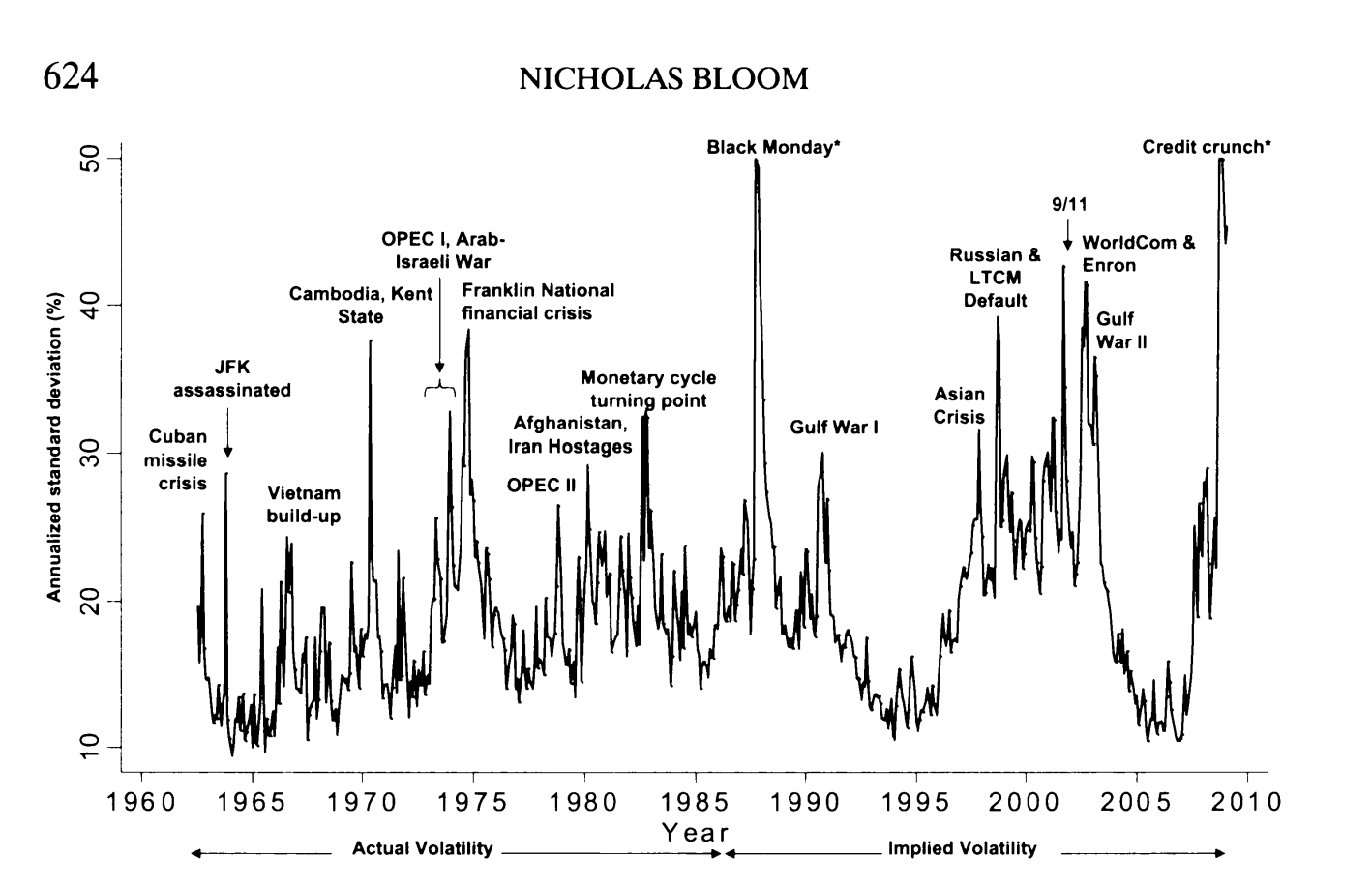
Plus, it doesn’t even measure what you’re trying to measure. Suppose the uncertainty of firms forecasts increases, but in a way that is uncorrelated with each other. If you’re holding an index of stocks, you have no reason to trade. Jurado, Ludvigson, and Ng (2015) actually measure uncertainty itself, and find that major episodes are extremely rare (although they are economically impactful).
Uncertainty definitely can matter. Handley and Limao (2017) pursue a really cool idea – the accession of China to the World Trade Organization didn’t actually change the tariffs of the United States, which were already low, but it put those low rates on a sound footing, not requiring yearly renewal by Congress – and they find quite large effects, the equivalent of a 13 percentage point decline in tariffs. But, when we try to fit the facts to the Great Recession, the best we can get is 2.5 percentage points of the unemployment rate. That paper, Bloom, Floetotto, Jaimovich, Saporta-Eksten, and Terry (2018) is one which I see as the lawyerly case for uncertainty as a contributor to the Great Recession – it is not dishonest, but at every juncture, it sees how far uncertainty as an explanation can go. Its numbers should be taken rounded down, and in any case, it cannot explain persistence.
Nor should we be so confident that papers which say “uncertainty” actually mean “uncertainty”. Eduard Schaal (2017) attributes 40% of the increase in unemployment during the recession to uncertainty, but I think a close reading reveals that it’s not uncertainty as we would think of it. We do not see the real options channel matter. What happened is that the dispersal of shocks across firms was bigger than usual, and since firms could not hire and fire quickly enough to match, output went down.
So it’s all well and good to point out cool mechanisms around uncertainty – I think “Uncertainty Traps”, for instance, which proposes that firms delaying investment itself delays discovering information about the world, further increasing uncertainty, is a cool idea – but I think we have to conclude that it was of limited quantitative importance.
Is AI a bubble?
Well, is it?
I guess that would be the thing to know. What I mean is, if it were a bubble, could we have another Great Recession?
This is an enormously important question. I think we should be clear that the Citrini Research story of an AI boom leading to mass immiseration is not going to happen. See Alex Imas’s article on the subject. At the time of writing I was actually working for Prof. Imas, and I thought the assumptions required to get immiserizing growth were so ridiculously strong that it wasn’t even interesting to argue against – who could possibly believe it to be the case? Then along comes Citrini a few months later.
What is actually interesting is if GPUs are actually making their way into the economy as quasi-money and collateral for loans. This is something which I genuinely don’t have an answer to. However, I believe that the current size of the assets used as repo is limited relative to the size of the repo market more generally. Moreover, the toxic assets of the time were rated as being of the highest quality, while these are rated as risky corporate debt.
Well that just about wraps everything up. Is there anything you’d like to say at the end?
I would first like to thank Basil Halperin for taking a look at the draft, and Scott Sumner for commenting. I would also like to thank Tyler Cowen for taking a chance on me, back when my blog stank, in supporting my writing.
The Great Recession was really, really bad, and it was largely the result of mistakes. Because I believe that the number of mistakes made can be reduced by study, and that the amount of study is responsive to investment, I think it’s actually really important to invest in producing economists. (Shocker, I know). The same is true for the other real sciences, but it is just as much so for economics.
I would also like to ask for your support. If you have made it this far in the article, I presume you must have liked it and found it interesting. I chose not to paywall this, but I could have. I would have traded perhaps ten people subscribing for several thousand never reading it. Does that seem like an efficient trade to you? If you like what I have done, please consider getting a subscription. It would mean a lot to me.