Do Developing Countries Still Need to Industrialize?

For decades it has seemed that there is only one path to growth. Countries start out full of peasants, engaged in resource extraction from the soil. The methods of production are inefficient, and there are far too many people in the countryside, kept there by the primitive communism of the family. Gradually, people leave the countryside to enter low-skilled industries, which slowly improve into industries of increasing productivity and skill. As companies become larger, they require more and more clerical and managerial staff; eventually the country predominantly produces services, with agriculture and manufacturing being diminished in relative size but of enviable productivity. It is possible for a country to become rich through exceptional luck in the resources it has available – largely oil, though sometimes diamonds or copper – but it is not something to be relied upon, and in any case the parasitic government enabled by only needing to control the soil and not have good policy is apt to undo anything good.
Development economics has been so settled on this recipe that we have focused only on questions of genuine uncertainty. Hence, the widespread use of RCTs in developing countries for poverty alleviation. Within the countries which we expect growth to be possible, the only debate is on how much the government should intervene to prod things along – industrial policy – or whether it is sufficient to simply create the right conditions and allow private enterprise to grow unhindered. Countries where RCTs take place, with the exception of the Indian subcontinent, are essentially on permanent hospice care.
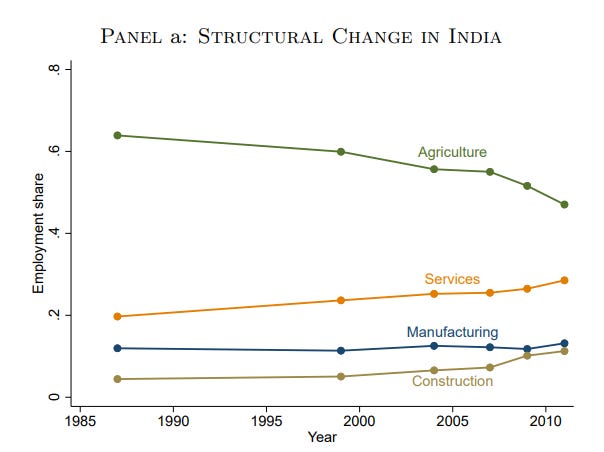
And yet, things seem to be changing. If you look at India today, which grew at a rate of 4.2% a year from 1987 to 2011, the majority of growth was taking place in services which sold directly to the consumer, as did most of the productivity growth. We are drawing here from Fan, Peters, and Zilliboti (2023). People moved out of agriculture, but they did so into services and construction, not manufacturing. (Importantly, services which are sold to other businesses are lumped into manufacturing, because it should be properly thought of as an input into traded goods).
It’s possible that it’s peculiar to India, which is notoriously hostile to large manufacturing firms. To cover a few of the big ones, many products were reserved to only small firms to be manufactured, and the removal of that (partly after our study period) was found by Martin, Nataraj, and Harrison (2017) to substantially constrain manufacturing growth. The Industrial Disputes Act, after its amendment in 1982, required that firms with more than 100 workers obtain government permission in order to layoff anyone; permission that is rarely granted. If you make it impossible fire anyone, you also make it impossible to ever willingly hire anyone. (If you wish, you can imagine me saying this by jumping up on the table and shaking you by the lapels – it’s insanity). The License Raj made it so that you needed government permission to change your products, import new products, or even to produce more, and the MRTP made it so that large firms basically couldn’t buy other companies by default. Much like the situation today in cities hostile to building, these explicit laws are accompanied by a thicket of smaller regulations, and a hostile attitude to working productively with firms.
It is no surprise, then, that manufacturing firms are much smaller in India and grow much less over time than in America (Hsieh and Klenow, 2014). However, when we look around the world, we see a similar story. People are moving out of the countryside, but into providing services in cities, not manufacturing.
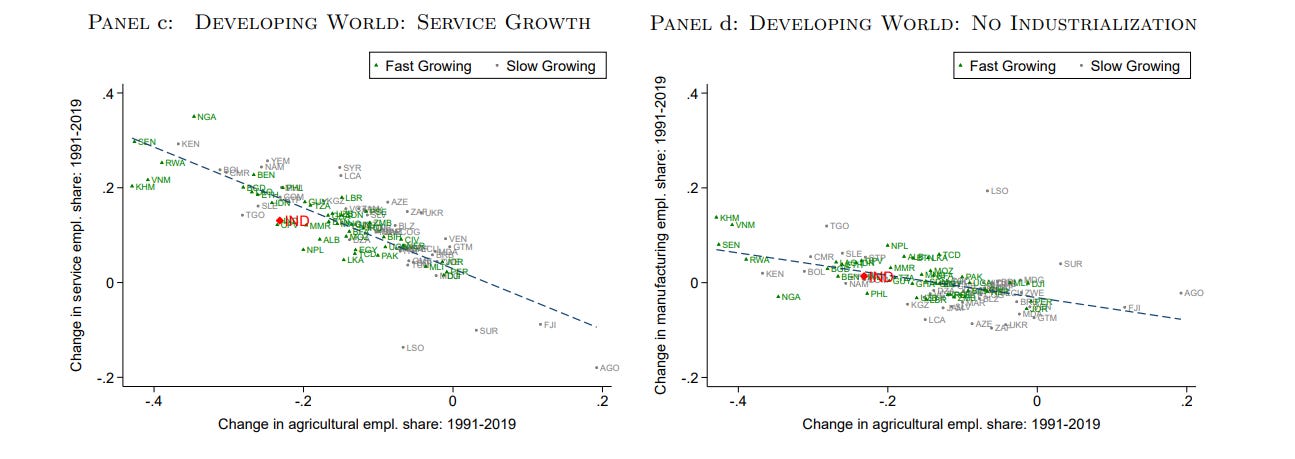
This is not just people moving into disguised unemployment. Work by Peters, Zhang, and Zilibotti (2026), using data on durable good possession in East and West Africa as a proxy for income, shows that they enjoy standards of living comparable to people who are working in manufacturing.
And yet – and yet. I do not think that service led growth can allow for take-off, unless those services are traded outside the city. I think it is instructive to look into how the Peters and Zilibotti papers work. In constructing a price index, we generally start with the assumption that preferences are homothetic, which simply means that the proportion of different goods that we buy is not influenced by income. If everyone got richer, they would still spend some constant fraction of their income on food and non-food items. This is obviously not true, of course, but what it does do is make aggregation possible. We can get a representative consumer with the average preferences of the whole population very easily
To get aggregate preferences with non-homotheticities, they turn to the price-independent generalized linear demand system, or PIGL. At each point in time, we can see that people of different income levels spend different fractions on different goods, with food in particular being the one that sees a decline in fraction of expenditures. This is called the Engel curve, incidentally (not that Engel!). They choose a Cobb-Douglas production function, which means that production of a final good is a log-linear sum of inputs. (This builds in declining returns to any given input). Since PIGL also deals with things which are log-linear in prices, plugging them into each other allows us to fully identify how people change preferences across the different sectors.
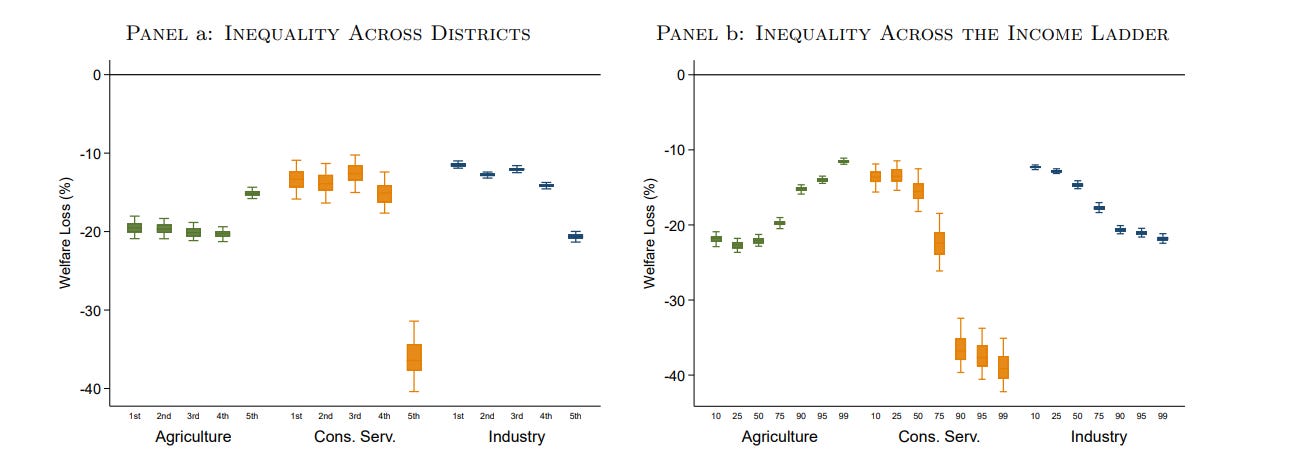
This was something of a detour, but in their framework, improvements in consumer services come as a multiplier to an increase in income due to other sources. As people get richer, they demand more and more of specialized consumer services which are now able to be provided efficiently in towns. Because service-led growth provides the services which people want more of when their income rises, the gains from it disproportionately accrue to the wealthy. Figure 6 thinks about the value gained from productivity improvements by asking how much of one’s income one would prefer to give up rather than have productivity in that sector reset to the level
The emphasis on non-homotheticities should also make it clear why a country is often not really able to get rich by simply getting better and better at agriculture. As the income of a country rises, they will want less of the good. Trade, of course, breaks this, but if we grant that food is costly and bulky to ship, and certainly much less of a tradeable good than manufacturing, agriculture goes back to being less important. In the case of India, we can get the right answer from Asher, Campion, Gollin, and Novosad (2022), who use irrigation canals to trace out the impact of agricultural productivity improvements. They do not cause people to change the activities which they do, or raise the income of workers (the gains accrue to the landowners), but they do cause people to live in towns more.
(Incidentally, there is a particular family of instrumental variable methods you should be aware of as an economist. Water, famously, does not flow uphill. This means that places very close to each other, but with a difference in elevation of only a few yards, get very different exposure, which is ACGN’s identifying variation here. This approach starts with “Dams” by Esther Duflo and Rohini Pande, and another notable paper using it is this one on sewage access).
In order for agricultural improvements to raise income, there must be trade with the outside world. Akerman, Moscona, Pellegrina, and Sastry’s paper on the Brazilian agricultural revolution and Embrapa is instructive here. Embrapa is a state-owned research corporation which created improved variants of crops, largely soybeans, which were suitable for local climatic conditions. The identifying variation here is the similarity of climatic conditions across great distances; if a research station was placed somewhere that has similar conditions, but a thousand miles away, it seems likely we are picking up the effect of the R&D, not something which is associated with the placement of the station (like government favoritism).

The program, by their estimates, doubled the productivity of Brazil’s agriculture, and was responsible for 40% of the growth in agricultural productivity during that time. Bustos, Garber, and Ponticelli (2020) argue that places which were more integrated with soy producing regions through networks of banks saw greater industrialization, because the businesses could borrow more cheaply.
The point of all this is that we should think of service-led growth as a multiplier on the productivity improvements of other sectors, and not a source of growth in itself. You still need to do something which can be traded. I see this as a continuation of a theme I touched on last year — there is no reason for the sector in which you observe productivity growth to be the sector where the technological change causally responsible for that improvement is actually occurring.
However, this does all imply that we should be more optimistic about cash transfers as a method of poverty reduction. I will discuss this more in a later post, but we should expect positive multipliers to an unconditional increase in income, which we do indeed see from studies tracing out the general equilibrium effects of cash transfers.
I would pose the question differently. Can developing countries get rich but focusing on tourism as opposed to manufacturing?
I would recommend providing at least a third of your SEZs to foreign resort companies where gambling is legal.
Is it possible India is relying on expats (temporary or permanent) remitting or bringing back funds from abroad as a quasi-tradable sector?
I recall Modi & Europe were recently in some trade talks and his big ask was more permits for people to work/live in Europe. Which would fit very comfortably with them trying to create non-industrial tradables.